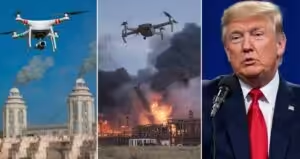

US President Donald Trump will be briefed by Pentagon officials with new military strategies on Friday as the confrontation between Washington and Tehran.
Continues in a new phase regarding the Strait of Hormuz with the looming 60 day deadline for military action, and as Australia moves quickly to secure oil supplies in the face of the worst energy crisis worldwide in years.
The US President’s national security council presented Trump with several options for the situation in the strait, which is under threat due to a combination of Iranian provocations and the US naval blockade in the area.
Trump was clearly determined to maintain his blockade, despite the lack of progress in negotiations with Iran and soaring oil prices above US$100 per barrel.
On Wednesday morning, Trump posted on Truth Social that Iran could not “get their act together” and should “get smart soon.”
He seemed unwilling to resume airstrikes and told reporters later in the day that he believed no such attacks would be needed, although he would not say that outright.
The diplomatic prospects look bleak. “This week, Secretary of State Marco Rubio said, any agreement must permanently prevent Iran from pursuing nuclear weapons.
Iranian President Masoud Pezeshkian said the US was using a naval blockade as a pretext for expanding military operations and the approach was “intolerable”.
Congressional jitters and war powers
Friday marks 60 days since Trump informed Congress of military action against Iran.
The War Powers Resolution says the president needs congressional approval to keep operations going beyond that time, or to start pulling troops out.
“Defense Secretary Pete Hegseth testified to the Senate Armed Services Committee yesterday that the ceasefire that was put into place on 8 April either freezes or suspends the statutory clock”.
Republican Senator Lisa Murkowski says she will introduce an authorization to use military force the week of 11 May upon the return from the Senate’s current recess, unless the White House presents a credible case prior to then.
Murkowski sees the proposal as a means of requiring the administration to set out objectives and to brief Congress on the status of progress, while creating clear conditions for withdrawal from the region.
Australia scrambling amid fuel crunch as crisis escalates
The economic implications of the conflict can be felt keenly at home in Australia, where 85% of the nation’s fuel is imported.
Latest News: Trump lavishes praise on King Charles while pointedly ignoring Starmer as royal visit shifts to New York
As the Strait of Hormuz has essentially been shut down since mid February, Canberra is working to secure alternate sources of fuel and protect households from rising prices.
Through its newly acquired power to create a Strategic Reserve, the federal government has acquired an extra 400 million litres of diesel, which have come into the country via ships from South Korea, Brunei, and Malaysia.
Additionally, a further 4.6 billion litres of crude, diesel, jet fuel and petrol will be imported into the country within the coming four weeks, as stated by the Department of Climate Change, Energy, the Environment and Water.
The government has cut excise duty from 1 April to reduce prices at the pumps by 26 cents per litre. Further cost reductions will come as states and territories will forego increased GST.
But diesel prices are still cripplingly high, averaging between 275 and 312 cents a litre in some areas.
Hundreds of service stations have reported temporary shortages, with rural and regional communities the hardest hit.
Even in the best case scenario, shipping flows through the strait of Hormuz are unlikely to return to normal before July.
The coming weeks will test whether government intervention can hold the line until global supply chains start to recover for Australian households and businesses already feeling the squeeze.