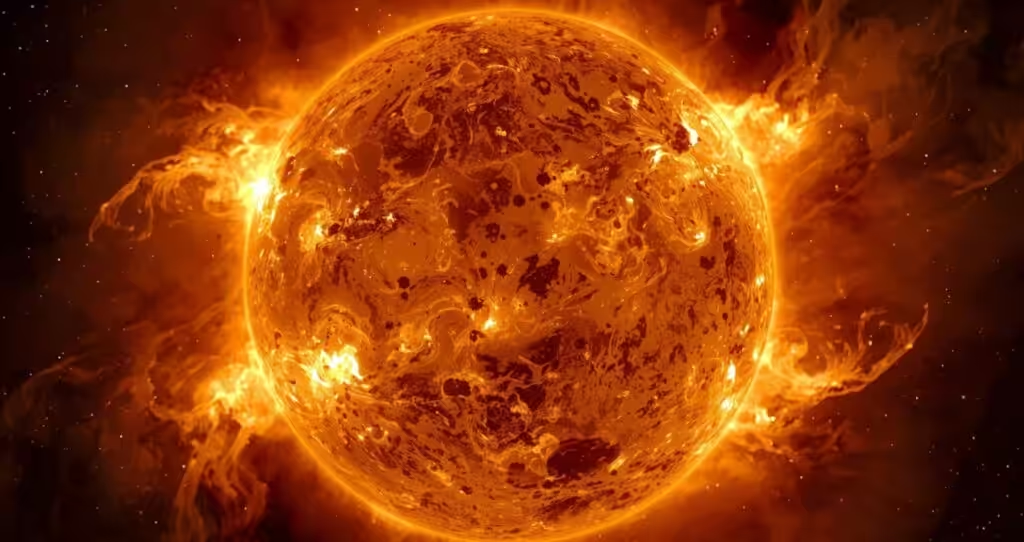

Two powerful X class solar flares were detected within a period of seven hours by the sun on April 24, which briefly knocked out shortwave radio communication in parts of Australia, the Pacific and East Asia.
The two solar storms were generated by an active region called AR4419 in the west of the sun’s disk.
An X2.4 flare burst at 9:07 p.m. EDT on April 23, followed later on by another flare X2.5 at 4:13 a.m. EDT on April 24. Both bursts were observed by the NASA Solar Dynamics Observatory.
According to Ryan French, a solar physicist, the two flares are the most powerful flares seen for the past 78 days.
Both solar flares are so powerful that the radiation travels at the speed of light and hit the earth’s surface in about eight minutes.
The first explosion resulted in a blackout in some parts of the Pacific and Australia, while the latter knocked out some East Asian countries.
Blackouts happen when the high energy particles resulting from the flares rapidly ionise the low level atmosphere called ionosphere, causing a blockage of the radio signals.
Also Read: Iran’s wounded Supreme Leader governs by courier as US tightens military grip
AR4419 had been squirming for days. On 2014 Apr 23 this region produced a series of M class eruptions, along with an unusual sympathetic flare, with two different sunspot regions on opposite sides of the sun flaring simultaneously.
Then came the twin X flares, hours later, taking the activity up sharply.
What comes next
Both flares were reportedly followed by coronal mass ejections (CME), major eruptions of magnetized plasmas into space.
In contrast to solar flares, CMEs require several days to reach Earth’s upper atmosphere due to the long distance separating our planet and the sun.
AR4419 being located at the solar western limb, rather than directly facing the Earth, means a direct hit is improbable but a glancing blow is not ruled out.
A strike by charged plasma clouds will lead to compression of the Earth’s magnetic field, creating geomagnetic storm conditions and moving auroras to low latitudes.
The recent flares serve as a reminder that the sun is still in a highly active phase.
The space agencies NASA and NOAA revealed last year that the sun had reached solar maximum, when sun spots, flares and CMEs are most frequent, occurring about once every 11 years.
Tech News: Meta to cut 8000 jobs as tech giant funnels billions into AI
While the current sun spot region has rotated away from Earth, it still poses some risk of eruptions directed toward our planet.
NASA recommends keeping an eye on space weather forecasting provided by NOAA’s Space Weather Prediction Center.