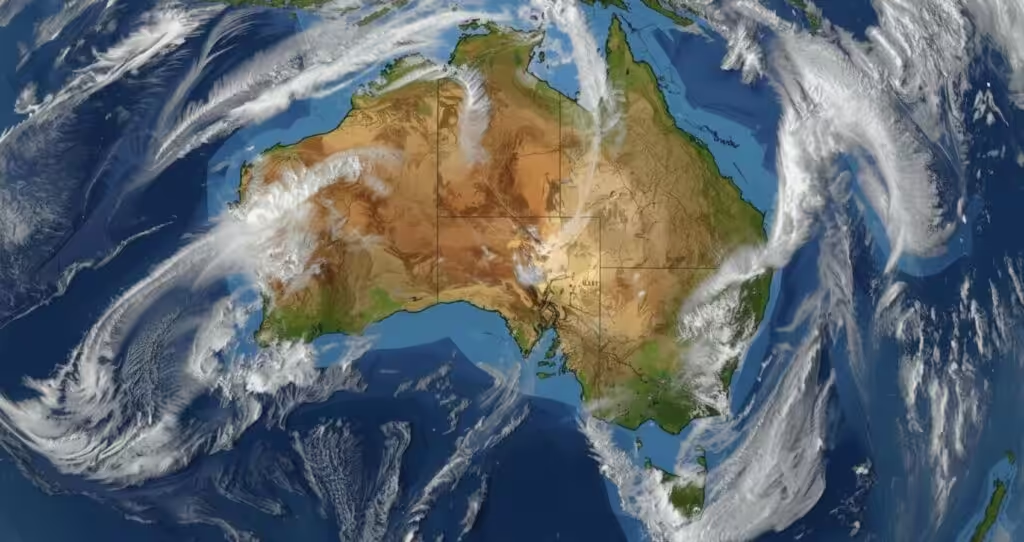

The year’s first major cold snap in Australia will soon begin affecting southeastern parts of the nation, bringing warnings of snow at low elevations, small hailstorms, gusts of strong wind and a rapid drop in temperatures.
The approaching cold front, which will affect Victoria, NSW, Tasmania and the Australian Capital Territory on Wednesday and Thursday, is part two of a wider weather event which had brought heavy rains and broken monthly records during the weekend in the south east of Australia.
This is expected to bring snowfall down to approximately 900 metres on Thursday in the mountainous areas, with the chance of snow falling below mountain level altitudes in tablelands in Victoria, NSW and the ACT.
Snow accumulations are predicted to be around 20 centimetres in the ski resorts of Victoria and NSW.
Melbourne, which has enjoyed an unusually warm run, will see the change especially starkly.
The city has hit 20 degrees or more on 13 of the last 14 days, but is forecast to reach only a maximum of 12 degrees on Thursday with cooler conditions expected to continue until at least Sunday.
Weather News: El Niño looms large as Pacific Ocean heats up ahead of Australian winter
Hobart will reach a top of 13 degrees on Thursday, while Canberra is forecast to hit a mere 10 degrees with snow likely on nearby ranges and a frosty weekend to follow.
The first phase was a low pressure system bringing extensive rainfall to Victoria, NSW and northern Tasmania over the weekend and into early Monday morning.
Some stations had their wettest May days in over six years, with 61 millimeters reported at Cabramurra, NSW and 81.8 millimeters at Mt. Hotham, Victoria.
The wettest day at Forbes Airport in over two years was 48 millimeters of precipitation.
With another cold front moving through during Monday, a westerly airflow will bring polar air southward as a precursor to an even stronger cold front to come on Wednesday night.
Showers, thunderstorms and hailstones are predicted in the southeastern states, and a sheep graziers warning may be issued in Victoria, Tasmania, and southern NSW.
For motorists travelling through the high mountainous areas, the most significant threat can be expected, especially with wet roads and snowfall.
The snow will please those who desire an early taste of winter but is not expected to build up lasting cover.
There have already been a few notable snowfalls in Tasmania this autumn and a late March dusting on the mainland, but this will be the strongest system for the mainland in 2026.
Temperatures will rebound across the southeast late in the weekend before returning closer to average for May early next week.