
The regime has conducted missile attacks for the entire first quarter of the year 2026, alarming various governments of the world and eliciting criticism from Seoul, Tokyo, and the US government.
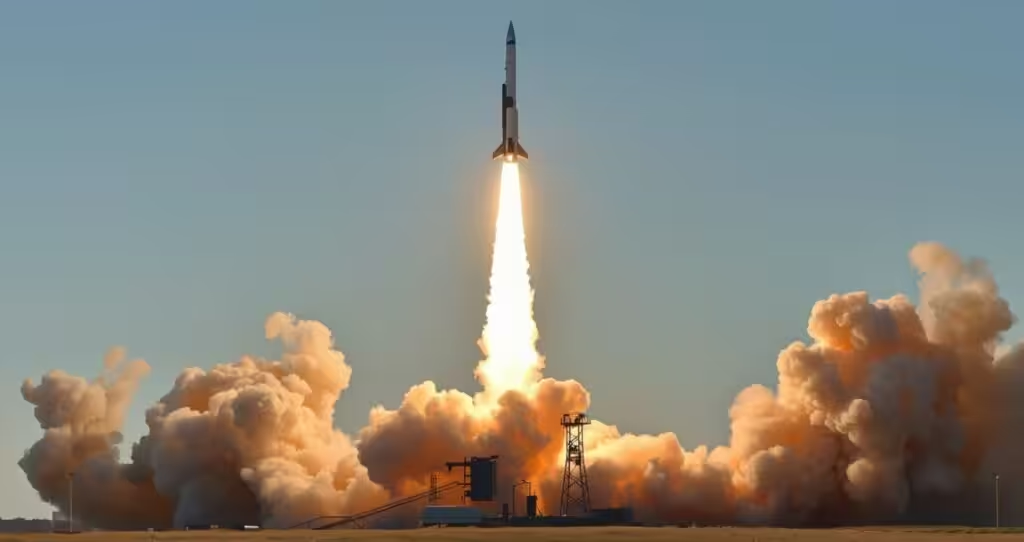
This is seen most recently in early April when the nation conducted three successive days of missile attacks using the following armaments, cluster weapons warheads deployed to ballistic missiles, electromagnetic weaponry and anti aircraft missiles.
These tests were confirmed by North Korea’s state run agency, who said that the cluster warhead on Hwasongpho 11Ka short range ballistic missile can wreak havoc on a target area ranging from about 6.5 to 7 hectares in size.
Multiple missile attacks have been recorded by South Korea’s Joint Chiefs of Staff on April 7 and April 8, including the firing of missiles from Wonsan coast towards the Sea of Japan, traveling a distance between 240 to 700 kilometres until crashing in the sea.
Asia News: Beijing tells citizens to avoid Seattle airport after scholars denied US entry
On April 12, Kim Jong Un directly supervised the firing of two cruise missiles and three ship to ship missiles from the 5,000 tonne destroyer Choe Hyon, the largest vessel in North Korea’s navy, which had been showcased in April 2025.
According to state news, the cruise missiles were airborne for more than two hours before hitting their targets through predetermined trajectories in the nation’s west oceans.
The capital of North Korea began the year in January by launching multiple ballistic missiles in the sea off the nation’s eastern coast.
In March, the military fired at least ten ballistic missiles from the KN 25 multiple rocket launcher at a distant island target around 360 kilometers away in the Sea of Japan.
Regional response
The Japanese Ministry of Defense reported that the April missiles landed beyond the country’s exclusive economic zone, while the Indo Pacific Command of the US stated that the launch did not pose an imminent danger to Americans or their allies.
Richard Marles, Deputy Prime Minister of Australia and Defence Minister, expressed his opinion called for regional countries to keep their sights on security challenges while crises were happening elsewhere in the world.
These provocations happened shortly after Pyongyang outright refused any possibility of improving relations with Seoul.
In a statement by Jang Kum chol, a high ranking official in the North Korean foreign ministry, South Korea would continue to be the most hostile enemy state to Pyongyang.
This trend is viewed as one of the elements of an overall strategy.
Also Read: Iran fires on ships as Strait of Hormuz closes again, Australia faces growing pressure to act
At the Ninth Party Congress held in February, North Korea vowed to strengthen its nuclear armament and accelerate the deployment of current delivery vehicles, both long range missiles and naval nuclear forces.
Another possible diplomatic twist seems to be coming: there were rumors that US President Donald Trump might seek a private meeting with Kim Jong Un during his trip to China in May.
It remains to be seen whether it will encourage or discourage further development of North Korean arms program.
For the time being, the pace of rocket launches doesn’t seem to slow down.