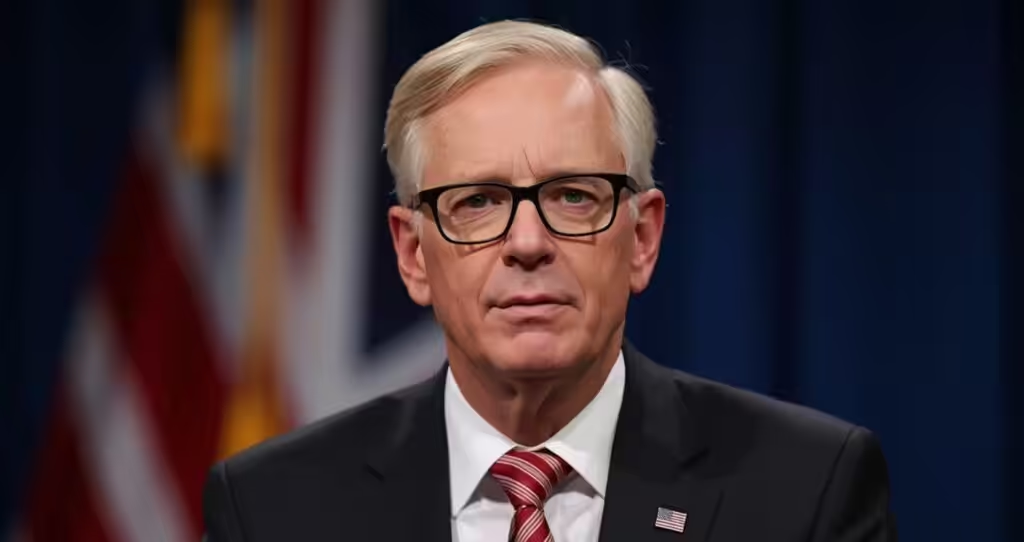

During Treasurer Jim Chalmers’ post budget address at the National Press Club on Wednesday, the politician used an unspoken warning to Pauline Hanson as part of his explanation of a housing tax overhaul that he said is necessary as politics of grievance gain traction both in Australia and abroad.
While the treasurer did not directly refer to the One Nation leader by name, it was clear what he was alluding to when he made his address.
It came only days after David Farley won the by election for One Nation in the NSW seat of Farrer, thereby making him the first Member of Parliament for the party in the lower house.
The treasurer went on to say that there is now “an accelerating sense that people feel disconnected and disregarded in the modern economy.” Ignoring that could spell serious trouble politically, he warned.
“I think the worst thing to do, the easiest thing to do, would be to leave things as they are,” Chalmers added.
In an interview before the Budget, he had adopted a more strident tone by pointing to swing to Nigel Farage Reform UK in British local elections.
“We don’t want to go down that path in Australia,” he said.
Investors push back on rental risk
The political rhetoric comes right at the top of one of the most controversial property tax packages in years.
Beginning July 2027, negative gearing on residential property investments will only apply to new constructions, while the 50% capital gains tax discount will be substituted by an inflation adjustment mechanism and a minimum 30% capital gains tax rate.
The reaction of the property industry has been tough.
Property Investment Professionals of Australia, Ray White and CPA Australia said that such a measure would result in an insufficient pool of landlords and increase rent prices.
Housing Industry Association stated that such reforms would decrease construction projects.
Master Builders Australia CEO Denita Wawn told SBS that the nation is currently 200,000 houses away from meeting its construction goals and this package could further worsen the situation, creating another shortfall of 35,000 housing units.
As Trent Saunders, Commonwealth Bank’s senior economist, has stated, the bank now expects that the dwelling prices will be down 3% compared to the case without the proposed changes, “with a smaller impact on rents.”
Modeling undertaken by Treasury, as referred to by the Treasurer, indicates an effect of slower price growth by about 2 percentage points.
Winners and losers
Australian working people will enjoy the introduction of $250 Working Australians Tax Offset starting from July 2027, together with an increased Medicare levy threshold for singles, families and pensioners.
Small business owners will be the beneficiary of a reactivated loss carry back scheme.
Senior Australians will receive access to another 5,000 beds in aged care facilities due to a $3.7 billion package of measures that include a reduction in the age uplift of the private health insurance rebate.
The suffering is experienced by property investors, trust fund beneficiaries and tourists who have to endure a $80 fee increase on passenger movements from the previous level of $70 starting 1 January 2027.
Foreign buyers are forbidden to purchase existing homes for two years to mid 2029.
The Australian Treasury has also cut down its growth forecasts due to increased costs resulting from the Iran crisis, which is expected to drive inflation up to 5% by mid year.
“I think there is going to be a scare campaign launched against us,” predicted Chalmers. “I think we will certainly come under a lot of criticism.”