Australia has dedicated one of its most sophisticated surveillance aircraft to a joint operation with the United Kingdom and France to protect commercial vessels in the Strait of Hormuz, amid indications that the precarious ceasefire between the US and Iran is about to break down.
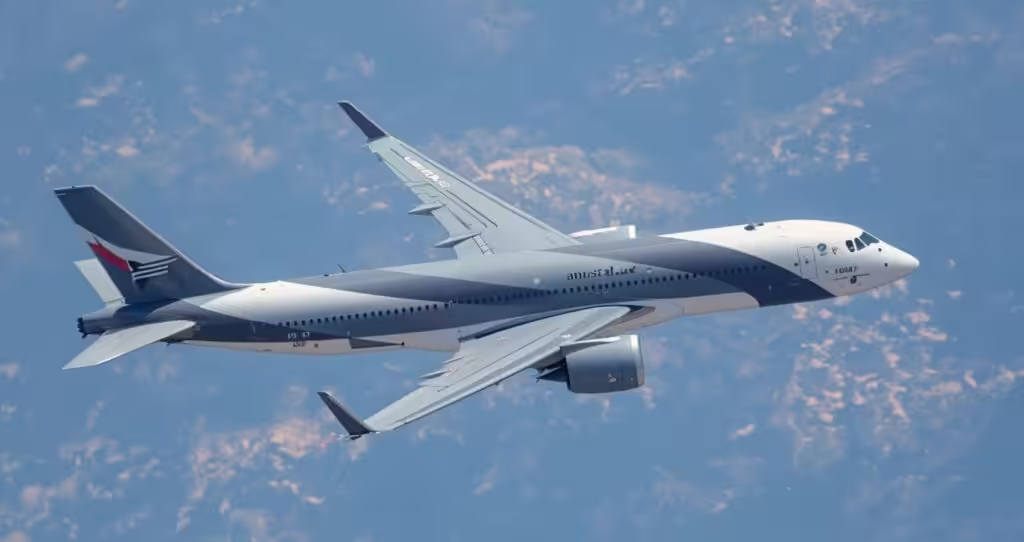
Defence Minister Richard Marles has disclosed on Tuesday the deployment of a Royal Australian Air Force E 7A Wedgetail, which comes in the wake of a video conference involving more than 40 nation defence chiefs.
The E 7A aircraft has been conducting operations in the region since March, when it has been protecting the United Arab Emirates from Iranian missile and drone attacks.
In a statement, Richard Marles, Defence Minister of Australia remarked, “Australia is ready to assist an independent and purely defensive Multinational Military Mission that will be run by the United Kingdom and France when it becomes operational.”
The aircraft’s function will be airborne early warning, detecting radar signals, missile launches, and aircraft flights in the water channel.
Michael Shoebridge, the founder of Strategic Analysis Australia, stated that the aircraft can make a valuable contribution only after Tehran permits traffic through the strait to start again.
The Type 45 destroyer HMS Dragon has been told to get into position in the area so it can join the coalition when the fighting officially ends.
France has already dispatched the Charles de Gaulle aircraft carrier to the Red Sea to demonstrate its intentions.
The diplomatic picture darkened this week when US President Donald Trump rejected Tehran’s response to a one page American peace proposal, saying it was “totally unacceptable” and a “piece of garbage”. “It’s on a lot of life support”.
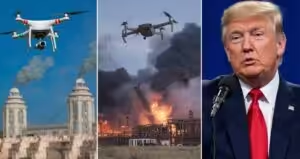
Trump’s Truth Social platform was bombarded with a series of computer generated graphics highlighting attacks on the ships, drones and aircraft belonging to Iran, with slogans such as “Bing, Bing, GONE!!!” and “Bye Bye, Fast Boats”.
The official White House Twitter account highlighted these posts in front of millions of people on X.
Defence experts say the visuals grossly exaggerate the actual effectiveness of US directed energy weapons and come at an inconvenient time for diplomats trying to preserve the ceasefire.
The hardliners inside Iran are demanding an even harder line from their side.
War News: Trump rebuffs Iran peace offer as US spy flights surge over Cuba and Gulf drone strikes mount
Ebrahim Rezaie, a member of the Iranian parliament’s security committee, told the United States that it should “surrender and make concessions” and adjust to a new reality in the region.
Meanwhile, hardline deputy speaker Ali Niksad warned that the United States will need to face the repercussions of challenging “a great and powerful Iran”.
The Iranian President, Masoud Pezeshkian, too, made a defiant statement of his own on X, saying,
“We will never bow our heads before the enemy, and if there is talk of dialogue or negotiation, it does not mean surrender or retreat.”
Treasurer Jim Chalmers, delivering the federal budget on Tuesday, blamed the conflict for slower growth and higher household costs.
“War in the Middle East has been pushing up prices, pushing down growth and punishing Australians,” Treasurer Jim Chalmers said in his budget speech.
High oil prices and flow on hits to commodities including fertilizer could force the country to the brink of recession, he warned.
The strait normally handles around one fifth of the world’s seaborne oil and liquefied natural gas and traffic has slowed dramatically since fighting broke out in late February.