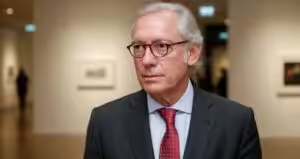

The signing of the energy security pact between the prime minister of Australia and Sultan Haji Hassanal Bolkiah of Brunei is part of the series of pacts the Australian Government has made with other ASEAN countries amid ongoing Middle East unrest.
The signed declaration, which comes right after official discussions in the Royal Palace in Bandar Seri Begawan on Wednesday, commits the two nations to cooperating on building their energy supply chain and ensuring unobstructed trade flows.
This is similar to the pact signed between the Australian Prime Minister and the Prime Minister of Singapore, Mr Lawrence Wong, last week.
The declaration highlights that both parties are committed to peace, stability and prosperity in the region through energy collaboration including renewables.
The sultanate is small in size, but it is a big fuel supplier to Australia.
Brunei is responsible for 9% of Australia’s diesel imports, 11% of its crude oil and 11% of its urea that is used as fertilizer.
Australian farmers are very worried about the upcoming winter cropping season because there is a shortage of fertilizer. This is because the same trade problems that are hurting fuel markets are also hurting fertilizer markets.
The fertilizer plant, which started production in 2022, has a workforce of approximately 600 people and it has a total capacity of producing up to 1.365 million tonnes of fertilizers per year.
Sultan Hassanal Bolkiah, who is one of the longest reigning leaders globally, received him warmly at his official residence in Bandar Seri Begawan.
He thanked the visiting leader, saying that Australia has been a reliable partner whose relations have continually grown stronger.
The current deal is among several diplomatic moves made recently by the Australian government in the region.
Last week, Australia and Singapore signed an agreement in which both countries agreed to work hard to fulfill each other’s energy security needs.
For instance, in the case of Brunei, Australia exported about three quarters of Brunei’s meat imports in 2024. On the other hand, when it comes to Singapore, it has been mainly about continuing LNG exports.
Next, Mr Albanese will be leaving Brunei for Malaysia, specifically Kuala Lumpur, where he will meet with Malaysian Prime Minister Anwar Ibrahim on the topic of energy security.
Why It Matters
The necessity of the visit becomes very obvious. In late March when the crisis reached its climax, there were more than 600 service stations around Australia where one or another kind of fuel was missing, especially in New South Wales and Victoria.
Diesel prices went up by more than 50% and fuel excise was cut down by half for three months.
90% of the country’s fuel is imported from other countries, but now the Strait of Hormuz is closed because of the conflict between Iran and the West.
Three major refineries located in Singapore’s Jurong Island cannot operate fully because their crude is usually shipped through the same Strait.
Also Read: US Navy blockade of Iranian ports holds firm, Pentagon says
The lack of fertilizer may become an additional issue since it can seriously influence the amount of crops harvested. It seems that the new Brunei agreement will settle all these problems with just one visit.
Experts in supply chains think it will take months for gas prices to get anywhere near where they were before the war.
The government’s plan for now is clear, get supplies from every willing partner in the region and hope that the diplomatic groundwork pays off before the reserves run out.