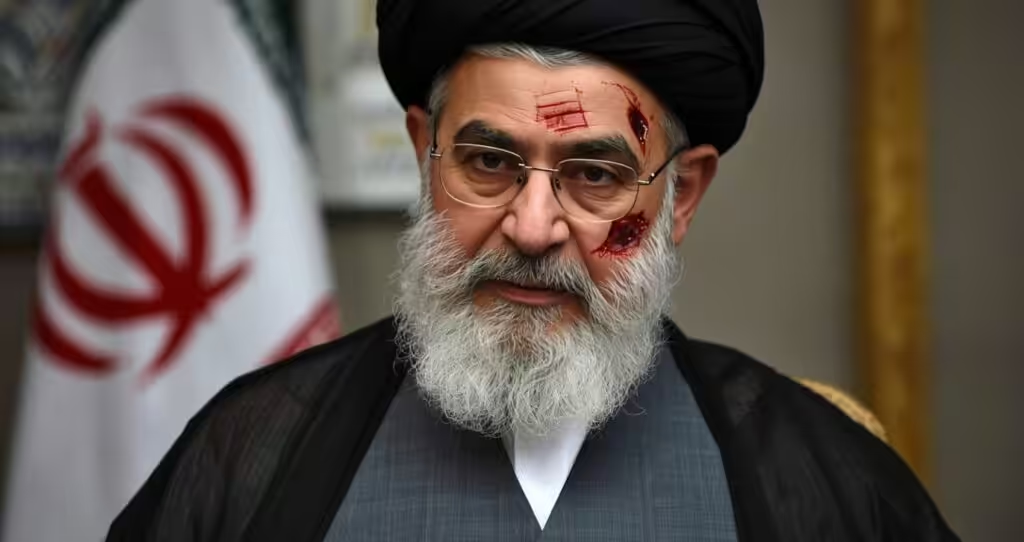

Two months following the United States and Israeli attacks which cost him both his father and predecessor, the current Supreme Leader of Iran, Mojtaba Khamenei, continues to suffer serious injuries while being kept out of the public eye.
According to a recent article featured on The New York Times, Khamenei’s injuries have been unveiled for the first time through reports by top officials and insiders of the country.
The 56 year old man had severe burns to his face and lips, making it nearly impossible for him to communicate verbally.
His leg had to be operated on thrice and he will now require an artificial limb. Also, surgery was performed on one of his hands where recovery is gradual.
Khamenei lost both his wife and son in the attack on February 28 where his father and former leader, Ayatollah Ali Khamenei, also died.
Officials insist that Khamenei is mentally sharp and engaged, but his condition is serious.
He has not appeared in video or audio recordings, apparently not wanting his first public address to project vulnerability.
The vacuum that has resulted due to his absence is now being filled by the more senior officers of the Islamic Revolutionary Guard Corps.
Also Read: Trump extends Iran ceasefire as Australia locks In 200 million litres of diesel
Parliament speaker Mohammad Bagher Ghalibaf, former IRGC intelligence chief Hossein Taeb, and retired general Mohsen Rezaei, are functioning as an informal decision making team in relation to the incapacitated president.
Sanam Vakil, who heads up the Middle East and North Africa programme at Chatham House, was quoted as saying that Khamenei is normally handed decisions rather than taking part in decision-making himself.
US beefs up military footprint
Meanwhile, while revelations regarding the weak leadership of Iran emerge, America has beefed up its military footprint in the area.
This week, President Donald Trump ordered the US Navy to open fire immediately against any ship laying mines in the Strait of Hormuz, a crucial maritime passageway that usually serves for 20% of global oil supply to travel through.
Trump stated that the US had “absolute dominance” over the waterway and only ships approved by the US navy could transit.
The strait has been mostly closed to commercial traffic since Iran closed it in retaliation for the opening strikes of the war.
The drop in daily ship transits from more than a hundred to single digits on most days has sent shock waves through world energy markets.
However, states that the military strategists within the United States military are currently coming up with new methods of attacking what is left of Iran’s coastal defenses in the region if the ceasefire breaks down.
Indeed, the two week ceasefire agreement made on April 7 seems like it is ending very soon because of stalled negotiations in Pakistan.
Indeed, with Iran having a physically incapacitated leader and its enemies growing more aggressive militarily every single day one cannot help but wonder what will happen next.