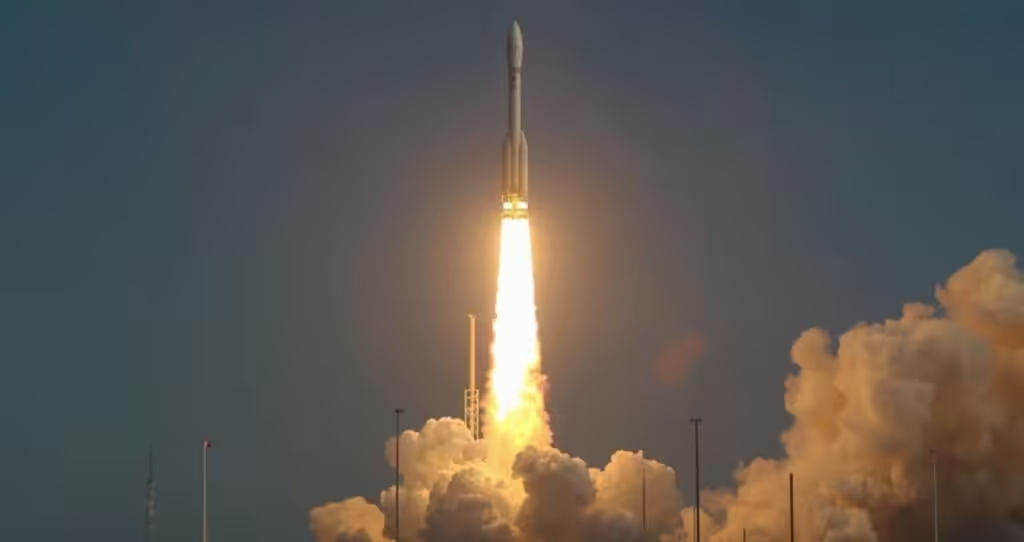

The new Glenn rocket from Blue Origin exploded in a dramatic explosion in a test at Cape Canaveral in Florida late Thursday night, delivering a severe setback to Jeff Bezos space company in its struggle to catch up with Elon Musk’s SpaceX.
This happened at around 9pm local time when the New Glenn’s seven engines fuelled by methane were being ignited as part of a static fire test at Cape Canaveral Space Force Station.
Static fire tests involve the ignition of the engines of rockets that are grounded on the launchpad, a common procedure to check systems prior to takeoff.
While the engines seemed to ignite successfully, some problem arose near the base of the spacecraft.
This led to an intense fire that started enveloping the 57 meter long first stage of the rocket.
It was then observed that the 26 meter long second stage of the rocket had started tilting and falling as the first stage collapsed.
The spacecraft must have been loaded with fuel during the test since the explosion has been considered the largest rocket explosion ever witnessed recently in the United States and the biggest failure in Blue Origin’s history.
There were no injuries. Houses shook in nearby Cape Canaveral and Cocoa Beach, and social media was flooded with reports of the blast.
Also Read: Jalen Brunson leads the Knicks back to the NBA finals for the first time in 27 years
Blue Origin confirmed the incident in a post on X, saying it had “experienced an anomaly” during the test and that everyone was accounted for.
Bezos wrote on X: “Too early to determine root cause but we are already working to identify it.”
A setback for Amazon’s satellite ambitions
The rocket was preparing for a June launch that will send 48 Amazon Leo internet satellites into orbit.
The flight was supposed to be the first of 24 launches Amazon has ordered from Blue Origin as part of the tech giant’s push to build a broadband constellation that competes with SpaceX’s Starlink network.
New Glenn has already flown three times since its first flight in January 2025.
In April, a commercial satellite failed to reach its planned orbit on its latest flight when an upper stage malfunctioned.
The Federal Aviation Administration had cleared the vehicle to fly again after reviewing that failure.
Blue Origin has one New Glenn launchpad, which is also the one that suffered damage during the explosion.
It is not clear how soon the company will be able to resume operations after losing both the rocket and the infrastructure at the launchpad.
According to Space Force officials, the accident is unlikely to have any impact on the launches planned by other companies from adjacent launch pads.
United Launch Alliance had scheduled the next Atlas V rocket to fly into space on Friday carrying its payload of Amazon Leo satellites.
Blue Origin will first have to figure out what happened and rebuild their facilities before resuming their launch schedule.