
The Islamic Republic of Iran has made a new offer for the reopening of the Strait of Hormuz, proposing to restore maritime transport through the strategically significant strait provided that the United States stops its naval blockade of Iran and ceases military operations against the country.
This agreement, which was communicated to the US by Pakistani mediators, will allow the postponement of the difficult problem of the Iranian nuclear program until a future round of negotiations.
This offer arose after private discussions between Iranian Foreign Minister Abbas Araghchi and the authorities of Pakistan over the weekend, according to two informed sources from the region who asked not to disclose their names.
War News: US Navy begins mine hunting in Strait of Hormuz as global oil supply hangs
In particular, press secretary for President of the United States Karoline Leavitt stated that Donald Trump discussed this proposal with his national security team.
However, Leavitt refused to state that the President is considering this offer. She stressed that there is only “a discussion”.
Marco Rubio was considerably tougher on his approach. In an interview, he called Iran’s plan to reopen the strait subject to Iranian approval and levying of tolls as unacceptable.
Rubio argued that whatever deal is negotiated should contain an element of addressing Iran’s nuclear ambitions, and it should not allow Iran to develop its nuclear capabilities under any circumstances.
Iran’s nuclear capability has been the crux of the problem.
Sources close to the negotiations report that Araghchi conveyed to the mediation team of Pakistan, Egypt, Turkey, and Qatar that Iran’s regime is highly divided about the nature of nuclear concessions it could make.
The move of Iran to segregate the problem of straits from the nuclear file suggests that Tehran is trying to maneuver itself through that bottleneck.
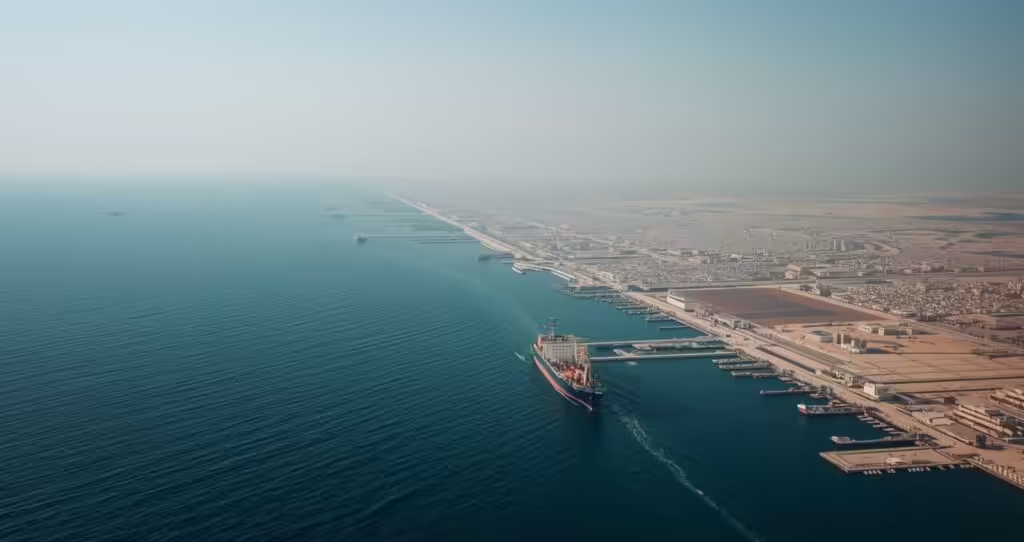
During peaceful times, almost a quarter of the world’s oil and natural gas is transported through this narrow strip of water separating the Persian Gulf from the open ocean.
As soon as fighting broke out, the Iranian Revolutionary Guard began blocking ships, intercepting them and deploying mines in the strait, which provoked a counter blockade of Iranian seaports by the US Navy.
Consequences for the economy are dramatic. The price of Brent crude has surpassed the mark of $108 a barrel on Monday, more than twice that seen before the war began.
Many nations came out in unison with a common statement made in tandem with Bahrain urging for the reopening of the water channel, while António Guterres, the UN Secretary General, addressed the Security Council, stating that the human suffering is rising.
The German Chancellor Friedrich Merz blamed the US for getting entangled in the war without having a definite exit strategy, offering minesweepers from Europe.
On the diplomatic front, Trump has cancelled the scheduled meeting of his envoys Jared Kushner and Steve Witkoff along with the Iranians in Pakistan.
In a press conference, he said that the response from Iran to him was much more satisfactory, without providing any further explanation.
Since a truce agreed on 7 April and extended indefinitely by Trump last week direct fighting has largely stopped but a permanent settlement is a long way off.
The straits and the nuclear matter remain unresolved. The two sides remain in competition for advantage.
It may be that the extent to which rising oil prices and international pressure ultimately affect Washington’s calculations will decide whether Iran’s latest proposal gains any traction or is quickly dismissed.