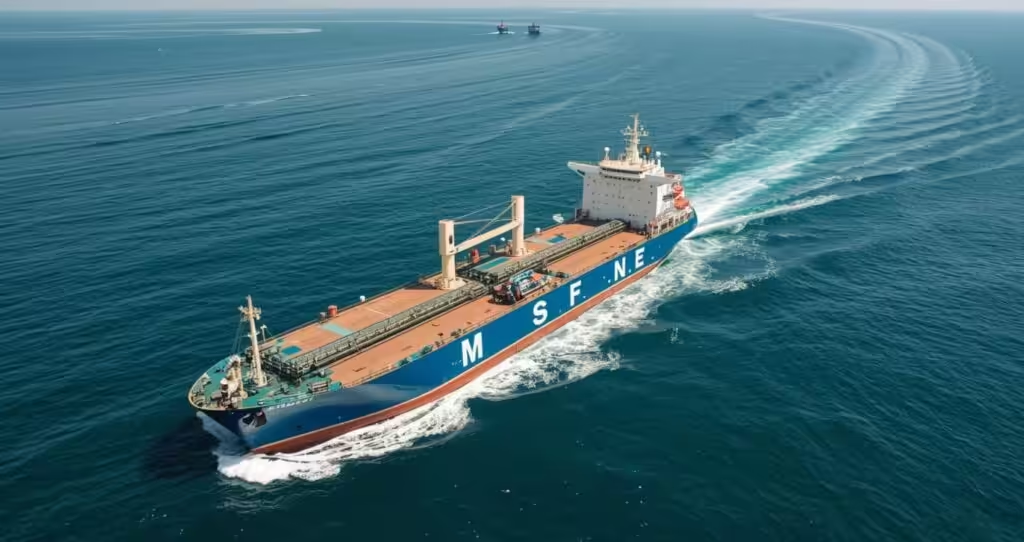

The American navy will conduct mine-sweeping operations in the Strait of Hormuz, which is a strategic channel that connects the Persian Gulf to the rest of the world.
It is estimated that about 20% of global oil is transported via this route.
President Trump has stated that the American navy is conducting a mission to open up this passage, which has been effectively closed to shipping activities for almost two months owing to the war between the US and Iran.
However, some experts believe that these activities might take months and will not guarantee safety for the shipping industry.
According to Pentagon officials, who briefed members of the House Armed Services Committee, the mission to sweep mines in this area can take up to six months.
It also appears that these missions will not be easy, especially considering that no one knows the exact number of mines that Iran has planted here.
All that is known is that there is a possibility of these mines being present in the pre-war shipping route in the strait.
Also Read: Iran’s wounded Supreme Leader governs by courier as US tightens military grip
The US Navy has two littoral combat ships in the Middle East capable of sweeping for mines, while two Avenger class minesweepers based in Japan had set out for the region but remained in the Pacific Ocean as of Friday.
The psychological aspect of the danger was pointed out by Emma Salisbury, a researcher with the Foreign Policy Research Institute and the Royal Navy Strategic Studies Centre.
The mine could even be deployed from a speedboat, according to her.
Contrary to popular imagination, modern naval mines do not resemble the spherical objects that can be seen in wartime films.
These mines usually reside on the ocean floor or are tethered to it via a cable. They can be detonated either by variations in water pressure or engine sounds as a ship passes above them.
According to reports, Iran has thousands of mines in its arsenal, mostly outdated Soviet versions but it is conceivable that some have been obtained from China or built inside the country.
However, even if mine clearance operations are successful, it will not guarantee the resumption of trade.
This week, the IMF warned that even if the ceasefire holds, global growth will be affected, with uncertainty over energy prices remaining a permanent drag on economies across the world.
The ceasefire between the US and Iran is still fragile.
Commercial vessels have been detained by both sides in recent days and tanker traffic through the strait is almost at a standstill, with Brent crude pushing above US$100 a barrel.
On April 23, Trump ordered the Navy to destroy any Iranian boats that lay mines.
So for now, the strait remains one of the most dangerous bodies of water in the world.
A full reopening will require clearing the seabed, but also persuading a deeply sceptical global shipping industry that the risk has truly passed. That may be the harder task on present evidence.