
Australia’s treasurer, Jim Chalmers, says that the Middle East conflict has the potential to impact negatively on the country’s economic situation.
In the latest attack, the Middle Eastern countries, the US, Israel and Iran have thrown more shocks into world markets over the weekend.
Addressing Bloomberg Television, outside a G20 summit in Washington, Mr Chalmers indicated that the global economy was experiencing “a really dangerous moment” because all nations were facing inflation and slow economic growth caused by the war and interruptions of the energy supplies.
He says that his budget would be an ambitious one although much leaner than expected since the conflict has produced an “extraordinarily volatile environment.”
High commodity prices mean more revenue in government coffers, estimated at $36 billion within the next four years.
However, it is the same situation that has brought an extra burden of $2.5 billion from reducing the fuel excise and fueling cargoes within the country.
The International Monetary Fund has told Canberra not to use the budget to give out money for living expenses that aren’t already covered.
They say that fiscal stimulus would only make inflation worse, which is already at some of the highest levels in the developed world.
Strait of Hormuz standoff escalates
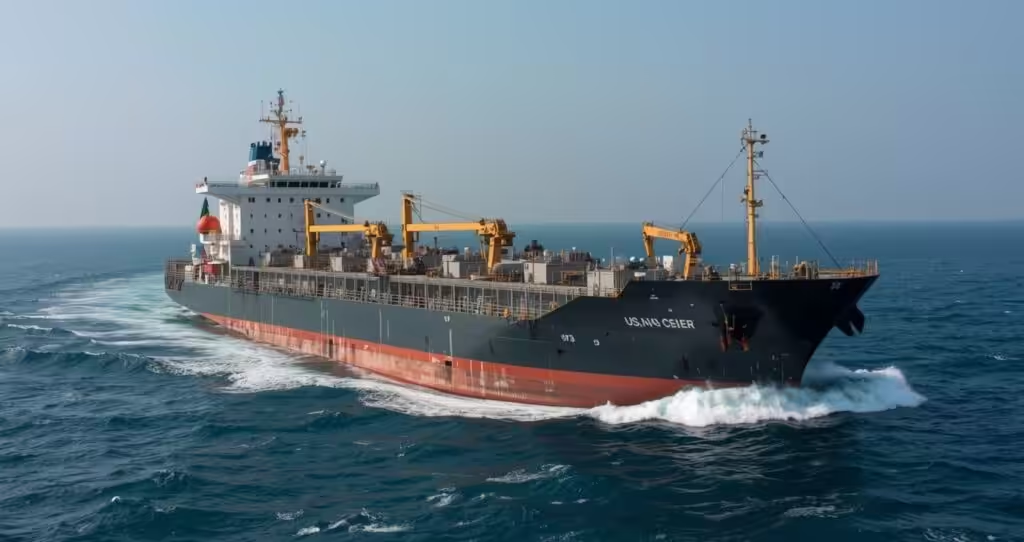
Relations between countries in the Persian Gulf took a turn for the worse on Sunday when the US president, Donald Trump, said that his country’s troops had captured an Iranian flagged cargo ship off the coast of the Gulf of Oman.
This was the first time that such a vessel was captured since the US government blocked Iranian ports in April.
The Iranian military called this an act of aggression and pledged to retaliate against the American forces.
No oil tankers were reported to have travelled through the Strait of Hormuz on Sunday, and the oil prices rose by about 7%, with the Brent crude reaching over US$96 per barrel.
About one fifth of all crude exports pass through this strait, and its closure since early February has been the main reason for increased fuel costs across the globe, including in Australia.
Trump also said that US negotiators, such as Vice President JD Vance, special envoy Steve Witkoff and his son in law Jared Kushner, would go to Islamabad on Monday for a second round of talks with Iranian officials.
Mohammad Bagher Ghalibaf, the head of Iran’s negotiating team and the speaker of parliament, said that there was still a big gap between the two sides, but he said that diplomacy would not be abandoned.
Pakistan has played an important role in mediating the peace process ever since it successfully negotiated a two-week ceasefire on April 8.
The ceasefire is set to end Wednesday.
The foreign office in Pakistan reported that communication was ongoing between the US and Iran via Islamabad, although no firm date had yet been set.
The critical issues of contention include the Iranian nuclear program, with Washington wanting a ban of 20 years while Iran proposes a 5 year ban, as well as the control over the Strait of Hormuz and armed groups operating in the Middle East.
Trump’s domestic standing takes a hit
The conflict is also taking its toll domestically for Trump.
According to News, an opinion poll conducted by the network on over 32,000 American adults revealed that Trump’s general approval rating has dropped to 37%, the lowest since he entered his second term.
65% of participants disapproved of his policies towards inflation and the conflict with Iran. Even amongst Republicans, there was a decline of four points to 83 percent over the past two months.
War News: Millions of barrels of crude oil may be permanently lost in War
With gas prices in the US averaging $4.05 a gallon and 40% of people saying their finances are worse than they were a year ago, the political landscape around the White House is changing.
Chris Wright, the Secretary of Energy, said that prices might not go below $3 a gallon until next year.
The numbers will be affected by whether the ceasefire holds, whether the strait reopens, and whether the oil markets stabilize. Chalmers puts the budget in front of parliament on budget night.