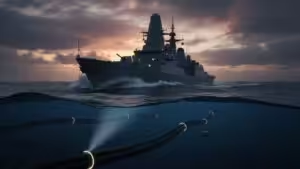

The Strait of Hormuz was once considered the most secure sea lane for global oil supplies.
It saw the transit of about 135 vessels daily carrying around one fifth of total seaborne crude and liquefied natural gas in the world.
Now the strait is effectively blocked due to factors going way beyond military risks.
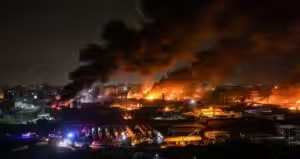
Following US and Israeli joint military operations targeting Iran in Operation Epic Fury on 28 February, the IRGC announced the closure of the sea route to all commercial traffic.
The next day, the IRGC officially confirmed the move and said it would burn any ship trying to use the route.
There have been at least 21 documented attacks by Iranians on commercial shipping vessels since then, with reports of mining being carried out too.
The insurance wall
As far as the premium rates for war risks insurance when traversing the waterway are concerned, they have soared from 0.15 to 0.25% of hull valuation to around 5 to 10% ever since the beginning of the conflict.
In case of a VLCC valued at around US$100 million, this means millions of dollars in extra expenses incurred during one trip.
According to David Osler, Lloyd’s List’s finance editor, insurance facilities are still available for those who can afford it indeed, ship owners are “not being held back by lack of insurance” but by concerns over their safety.
The consequence of this state of affairs is an unprecedented shipping bottleneck.
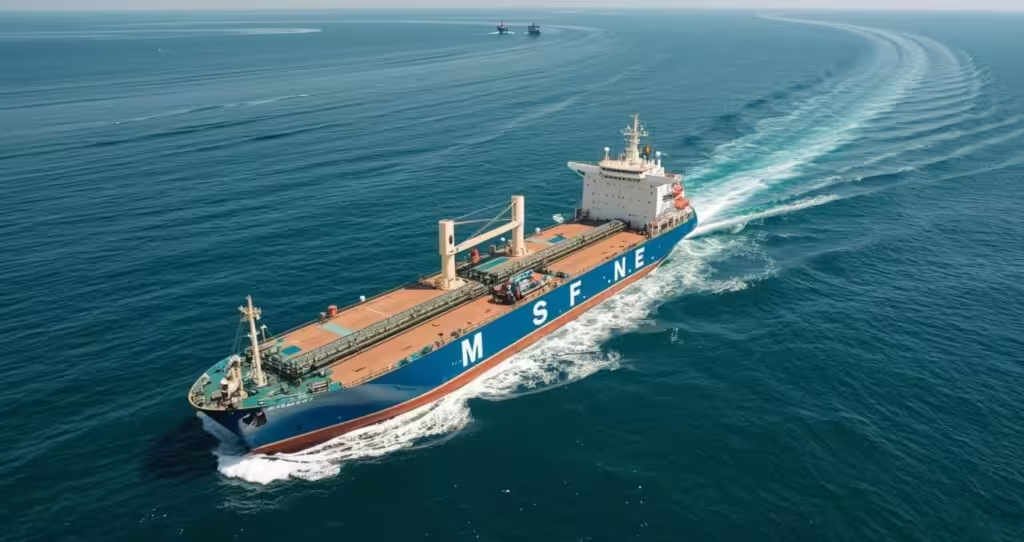
More than 800 merchant ships are now stranded within the Persian Gulf region, while more keep arriving each day.
According to the International Maritime Organisation, there are currently some 20,000 civilian mariners trapped onboard those vessels.
A selective tollbooth
However, Iran has not secured the strait entirely. Analysts argue that Tehran is maintaining a de facto tollbooth system that permits individual countries passage on a case by case basis.
The first five countries allowed safe passage through the strait include China, Russia, India, Iraq and Pakistan.
These countries had earlier negotiated with Iran to allow passage of their ships in the strait.
In the previous week, 53 transit attempts were recorded, the highest seen since fighting started though down by more than 90% compared to normal periods.
Other ships have tried innovative methods of getting out of the strait. In early April, three Omani tankers sailed out of the Gulf while close to the Omani coastline, totally bypassing the traditional Hormuz shipping route.
Hopes that a ceasefire announced on April 8 could pave way for exit from the strait were soon dashed when Iranian authorities stated that navigation would require approval.
Within a few hours, Iranian news agencies reported that tanker transit in the strait would still be prohibited due to attacks on Lebanon.
The major shipping companies aren’t leaving anything to chance.
Consequences of the closure of the strait are going to be felt in more areas than just oil transportation.
30% of global fertilisers pass through Hormuz, and during this time of year when the crops need fertilising, Iran was forced to cooperate with a UN request and allow humanitarian supplies, as well as fertilisers to travel through Hormuz.
For most of the world’s ships, the most important oil chokepoint will stay a stretch of water that is best avoided until the conflict is truly over.