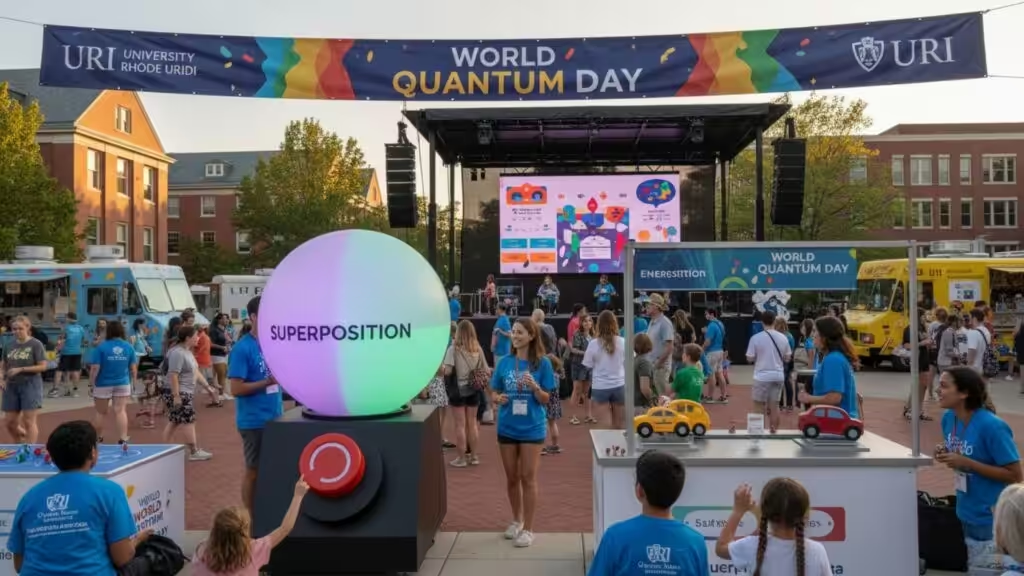
The University of Rhode Island held a free public event on April 10 that made quantum physics feel less like a classroom lecture and more like an open conversation.
The fifth annual World Quantum Day event took place on the Kingston Campus. URI’s Department of Physics hosted it and brought together politicians, tech leaders and university researchers to talk about how quantum computing affects everyday life, the arts and national security.
The talks on stage went far beyond complicated science language. Presenters discussed whether quantum computers need rules and limits, how quantum computing connects with the humanities and the arts and how new encryption methods can keep important information safe.
Speakers included U.S. Senator Jack Reed, Rhode Island State Senator Victoria Gu, representatives from Amazon Web Services and URI alumnus Christopher Savoie of SiC Systems.
Suhail Zubairy, a well known quantum optics researcher at Texas A&M University, gave the keynote address.
Visitors also got a look at the future Laboratory for Quantum Computing and Technology in URI’s Fascitelli Centre for Advanced Engineering.
The facility is set to open in 2028 and will include low temperature infrastructure, a clean room and a controlled unclassified information area.
One of the biggest announcements of the day was a new mini grant program for students. Amazon Web Services and the Institute for AI and Computational Research are funding it.
The program supports research that combines quantum computing with fields like the arts and social sciences.
Undergraduate students can receive $1,000 and graduate students can get $2,000. Proposals are due by May 1.
The program also welcomes students outside of STEM fields. The goal is to gather fresh ideas that can help shape how quantum technologies are built for the benefit of society.
For a field that many people find hard to understand, the Kingston event showed that getting the public involved in the quantum conversation is not just possible but already happening.