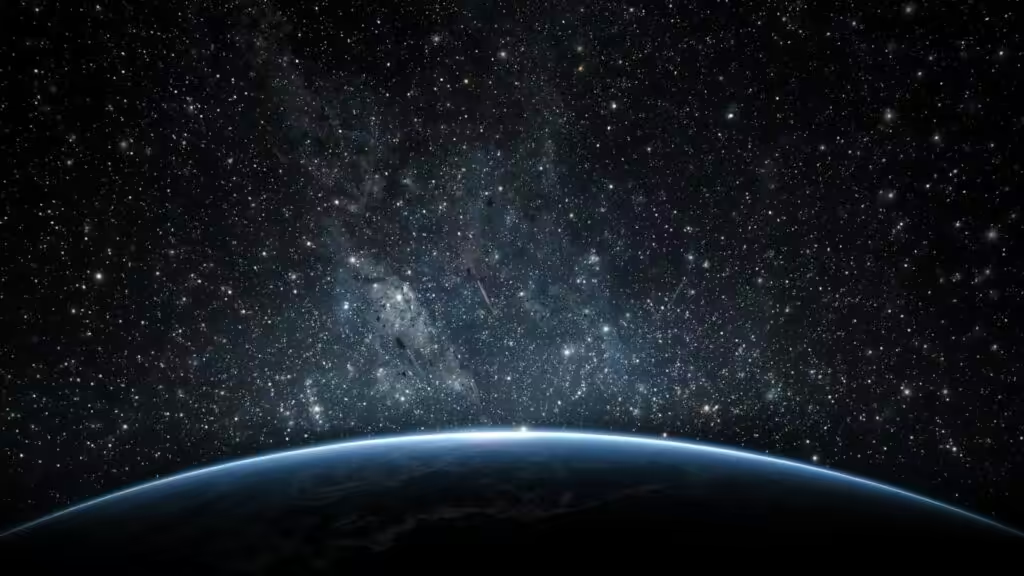

Fewer than 4,500 stars are visible to the naked eye on a clear, dark night. If SpaceX gets its way, the number of artificial satellites overhead could soon dwarf that figure entirely.
The company filed a request with the US Federal Communications Commission in January seeking authorisation for a new constellation of one million satellites in low Earth orbit.
These would not be internet relays like the existing Starlink fleet. They would function as orbital data centres, designed to run artificial intelligence workloads powered by solar energy in space.
To grasp the scale involved, consider this: roughly 14,500 active satellites currently circle the planet. Approving the proposal would increase that number by nearly 70 times.
Researchers who modelled what the sky would look like under those conditions found that for large portions of the night and year, visible satellites would outnumber visible stars, everywhere on Earth.
SpaceX is not the only company proposing to reshape what we see when we look up. California startup Reflect Orbital wants to deploy as many as 50,000 mirrors into low Earth orbit, designed to beam concentrated sunlight back to the ground.
The company markets this as extending useful daylight for solar farms and industrial sites. Its first test satellite, Earendil-1, could launch as early as this month, carrying an 18-metre square mirror.
From the ground, the reflected light would appear as bright as a full moon when directly in its beam.
Also Read: From Bilbies to Hot Cross Buns: How Australians Are Keeping Easter Traditions Alive Despite Rising Costs.
Both proposals have drawn opposition from virtually every major astronomical body. The Royal Astronomical Society, the European Southern Observatory, the International Astronomical Union, and the American Astronomical Society have all filed comments with the FCC opposing the plans.
DarkSky International, the leading advocacy group against light pollution, has published open letters to both companies calling for full environmental reviews before any launches proceed.
The concern extends well beyond professional astronomy. A study published in Nature in December 2025 found that if currently proposed constellations are completed, one third of Hubble Space Telescope images would be contaminated by satellite trails, while more than 96% of exposures from future space observatories would be affected.
Wildlife stands to lose, too. Birds use stars to navigate during migration, and the addition of thousands of artificial points of light disrupts those biologically ingrained behaviours.
Tiffany Nichols, an assistant professor at Northeastern University who co-chaired the American Astronomical Society’s committee on protecting astronomy from satellite interference, has warned of rising bird deaths from collisions caused by disorientation.
Pollinators such as bees are also highly sensitive to light changes, with flow-on effects for ecosystems worldwide.
For humans, the implications are similarly unwelcome. Scientists at Northwestern University have raised alarms that cumulative light pollution from satellite constellations could disrupt circadian rhythms, the body’s internal clock, with effects ranging from impaired cognition to longer-term health conditions.
SpaceX’s filing with the FCC contained minimal technical detail about how it would manage heat dissipation, collision risk, or atmospheric pollution from the thousands of rocket launches required to build and maintain such a constellation.
The company has not yet demonstrated that its existing Starlink satellites can consistently meet the visibility threshold recommended by the International Astronomical Union.
The FCC public comment periods for both proposals have now closed. More than 1,800 comments were filed on the Reflect Orbital application alone.
The commission’s decision on whether to approve, modify, or reject either proposal has no announced timeline.