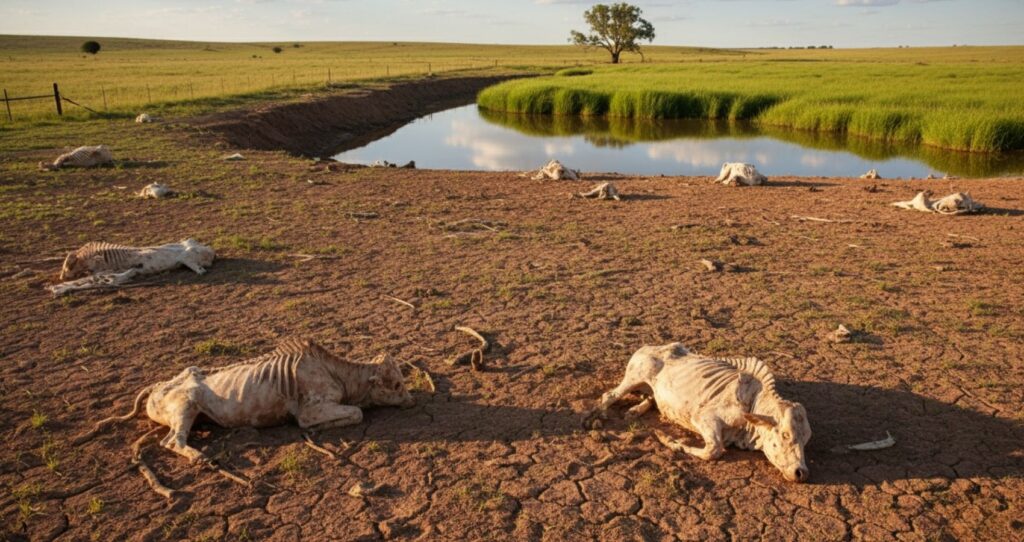

Thousands of cattle stranded on small pockets of higher ground across flood hit north-west Queensland are dying from thirst, hunger and exhaustion even as fresh rainwater pools around them and feed grows within sight.
Graziers say a mix of stress, fatigue and fear is stopping some cattle from stepping back into shallow water to reach grass or drink turning a wet season reprieve into a welfare and economic shock for a region that underpins a large share of Australia’s breeding herd.
On properties near Julia Creek and Richmond, producers describe mobs marooned on scattered islands across black soil plains that have sat under water for days.
In some cases, the water is not deep enough to block movement but cattle are reluctant to wade through it leaving station owners trying to coax stock to troughs and dry ground by buggy, bike and helicopter.
Queensland’s Department of Primary Industries has put the number of livestock dead or missing at 29,240 as of Wednesday evening with industry analysts warning the final total could be significantly higher as more country becomes accessible.
Grazier Emily Stevens reported that she had counted roughly 1,500 carcasses at one station approximately 70km north of Julia Creek.
She claimed that between December 18 and January 7, 742mm of rain fell, more than the area’s usual annual rainfall and leaving a large portion of the nation underwater or inaccessible.
Beyond deaths directly linked to floodwaters, producers are now dealing with follow on impacts including illness, exhaustion and skin infections after cattle spent close to two weeks in mud and water.
Prime Minister Anthony Albanese has announced an additional $38 million through the Disaster Recovery Funding Arrangements for affected north-west Queensland communities including disaster recovery grants for primary producers across shires including Carpentaria, Cloncurry, Croydon, Flinders, McKinlay, Richmond and Winton.
The package also includes extra funding for emergency fodder support and $11.5 million for repairs and flood resilience works at Cloncurry Airport.
The Bureau of Meteorology has warned of a moderate chance of a tropical low forming in the Coral Sea with the potential to intensify into a cyclone and push heavy rain back into already saturated catchments.
In the meantime, authorities and industry groups are urging road users to take care in flood affected corridors where cattle are sheltering on open stretches of highway and are warning that the full livestock toll and infrastructure damage across the region will not be known until waters recede further.