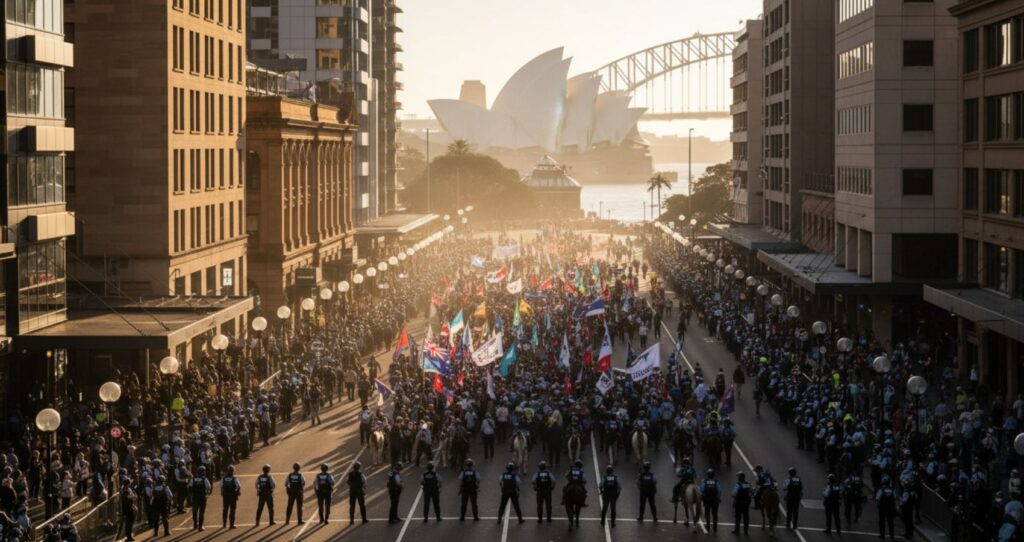

Hyde Park is now outside the restricted area and clearing the way for the Invasion Day march while limits remain across much of the CBD and the eastern suburbs.
NSW Police Commissioner Mal Lanyon has extended Sydney’s public assembly restriction declaration for another 14 days while cutting back the footprint of the ban to what he described as a significantly limited scope.
The declaration now applies to the Eastern Suburbs Police Area Command and most of the CBD while excluding Hyde Park.
The declaration affects how large rallies and marches can be organised under NSW’s Form 1 authorisation system.
Police said they will not accept Form 1 applications for public assemblies in the specified locations and any authorisations granted before the declaration are taken to be revoked.
Participants in assemblies inside the restricted zones also lose legal protections that ordinarily apply when an assembly is authorised, particularly around obstructing traffic and pedestrians.
The shift to exclude Hyde Park is expected to allow the annual Invasion Day march on 26 January to proceed from central Sydney with police able to authorise the event outside the restricted zone.
Lanyon said the aim was to strike a balance between public safety and the right to protest, urging calm as Sydney heads into a politically charged long weekend.
He said the restricted zone still stretches from Darling Harbour through the northern CBD and out to Oxford Street while taking in the eastern suburbs policing command.
The extension also leaves room for other events on 26 January to go ahead if they meet police requirements and are planned outside the restricted area that includes an anti immigration march organised by March for Australia which police have been reported as authorising to move from Prince Alfred Park to Moore Park.
The restrictions do not make all protests illegal but they change the risk calculus for organisers and participants by removing the formal authorisation framework for marches through key parts of the city.
NSW Police said gatherings are still permitted while officers may issue move on directions for obstruction, intimidation or harassment or conduct likely to cause fear and may require the removal of face coverings for identification purposes where they suspect offences.
Supporters and critics have framed the declaration as a test of how far emergency style policing powers should reach in a democratic system.
NSW Jewish Board of Deputies president David Ossip welcomed the latest extension as necessary in the wake of the Bondi attack while NSW Council for Civil Liberties president Timothy Roberts said the move had a chilling effect and accused the commissioner of acting politically.