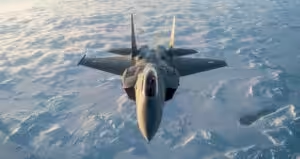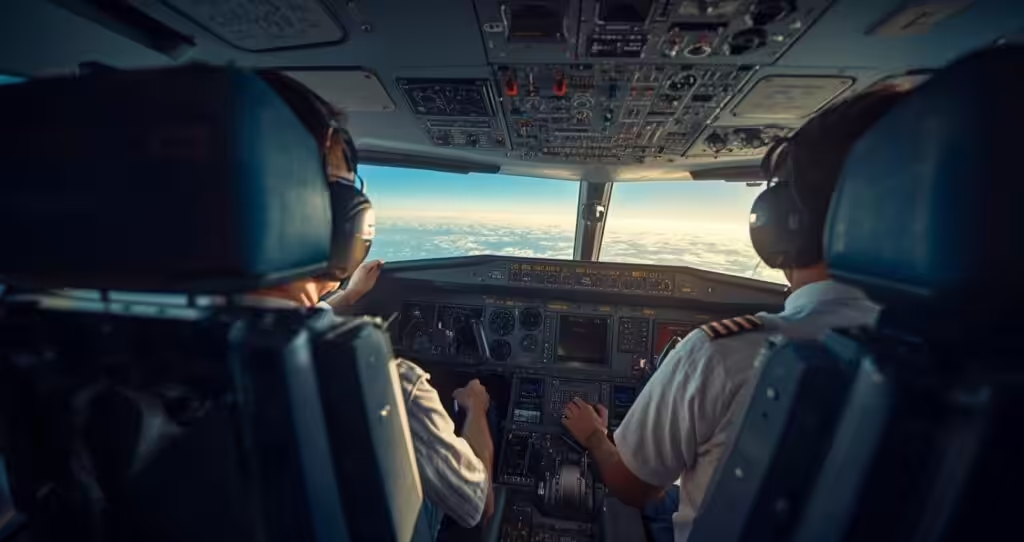

Three weeks on from when the United States and Israel began their strikes on Iranian military assets, prompting retaliatory missile and drone strikes across the Gulf, one of the world’s most important aviation routes is still in crisis.
Yet planes are still passing through the region, albeit through a network of restricted routes, military control and delicate negotiations between airlines and government officials.
Open up flight tracking website Flightradar24 and it is immediately apparent something is wrong.
Instead of one of the world’s busiest aviation crossroads, there is a huge blank space.
The airspace of Iran, Iraq, Kuwait and Syria is officially closed, while Israeli, UAE, Qatar and Bahraini airspace is severely restricted and at risk of closure at short notice.
The secret to how planes are still passing through the region lies in two main workarounds.
For flights between Europe and Asia, the usual Gulf routes are effectively off limits with planes taking either a northern route through the Caucasus and Afghanistan or a southern route through Egypt, Saudi Arabia, and Oman.
Airlines operate within strictly regulated safe corridors within the Gulf itself, which were created with assistance from civil aviation authorities and national air forces.
Etihad has adopted a more circumspect strategy, operating at about 15% of its typical capacity, while Emirates has been operating at about 60% of its pre conflict flight activity.
Qatar Airways, whose flights were effectively grounded for nearly three weeks, has commenced a new schedule until 28 March, re establishing links between Doha and over 70 destinations on six continents.
Also Read: Trump administration lifts sanctions on Iranian oil
The flights are taking off within a limited safe corridor approved by Qatar’s Civil Aviation Authority. Each flight is carefully planned and approved by aviation authorities.
The wider fallout
The crisis is affecting insurance and cost implications. Airlines in Europe, including Lufthansa Group, KLM and Air France, have suspended flights to several destinations in the Middle East until late March or even later.
Gulf Air has temporarily moved its operations to Dammam, Saudi Arabia, as Bahraini airspace is closed.
The airspace in Afghanistan is witnessing an increase in flights as they are diverted through the northern route, despite no air traffic control service since 2021.
As a precaution against renewed missile and drone threats, the UAE temporarily closed its entire airspace overnight on March 16 and 17.
This serves as a reminder that even partially open skies can close with little notice.
Right now, aircraft continue to fly across the Middle East. However, they are operating under strict restrictions, along narrow, vulnerable corridors and without knowing what the airspace map will look like tomorrow.