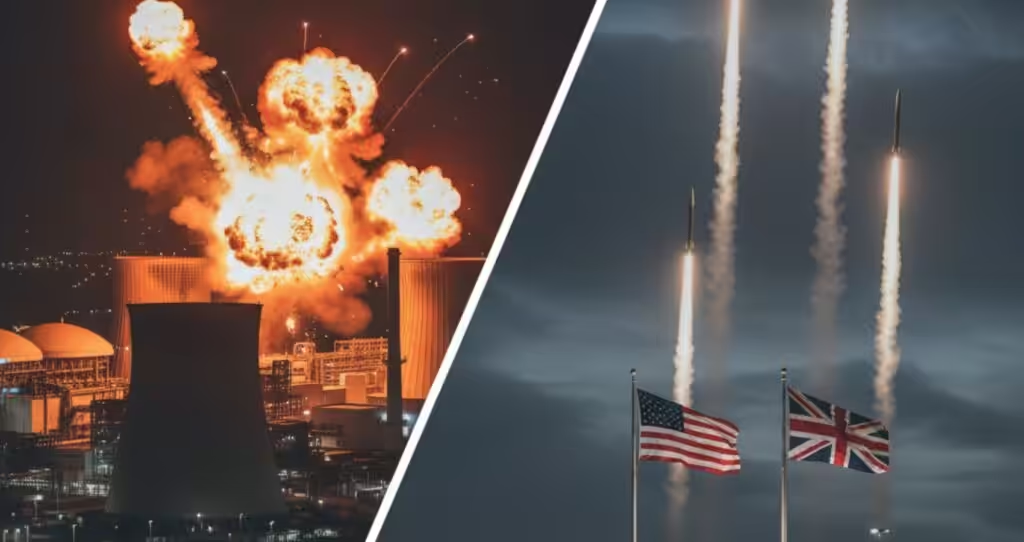

The major uranium enrichment plant in Natanz, Iran, has been attacked for the second time since the start of the war, just hours after Tehran launched two intermediate range ballistic missiles at the joint British American military base on Diego Garcia in the Indian Ocean.
It is the second time the plant has been attacked since the start of the war on 28 February, with satellite images earlier revealing damage to several buildings following the first attack on the opening day of the conflict.
The International Atomic Energy Agency confirmed receipt of notification from Iran regarding the attack on the plant.
The agency had earlier confirmed damage to the entrance buildings of the underground fuel enrichment plant following the first attack, but said there had been no radiological consequences.
Also Read: Denmark flew blood supplies and explosives to Greenland, fearing US invasion
Diego Garcia targeted in Iran’s longest-range strike
The attack on Natanz occurred simultaneously with a significant escalation in the other direction.
Iran launched two intermediate range ballistic missiles towards Diego Garcia, a distant island in the Chagos Archipelago which plays a vital role as a US base for heavy bombers, including the B2 stealth fleet.
Neither missile hit the base. One missile crashed while in flight and the US destroyer launched an SM 3 interceptor missile towards the other, although it remained to be seen if it had been successful.
The attempt to attack the US base had significant implications. It marked the longest range missile test by Iran during the conflict and showed capability far beyond the 2,000 km range that Iranian officials had admitted to.
The United Kingdom’s Ministry of Defence has condemned the attack, calling Iran’s behavior “reckless” and a threat to UK interests.
The office of UK Prime Minister Keir Starmer confirmed that ministers had granted permission for US forces to use UK bases for “specific and limited defensive operations” aimed at degrading missile sites that posed a threat to shipping in the Strait of Hormuz.
Conservative opposition leader, Kemi Badenoch, called the decision the “mother of all U turns.” The Liberal Democrats and Greens are calling for a vote in Parliament before any further escalation of Britain’s role in the conflict.
The war is now in its 22nd day, and it has expanded far beyond Iranian territory.
The kingdom of Saudi Arabia announced on Saturday that it had intercepted 20 Iranian drones in a matter of hours in its eastern region, where there are oil producing fields.
However, on Friday, Mr. Trump suggested that the US was close to achieving its objectives in the war, despite the lack of a ceasefire.
New Iranian Supreme Leader Mojtaba Khamenei, who took the position after the killing of his father, Ali Khamenei in the retaliatory strikes, has shown no signs of willingness to negotiate.
This second attack on Natanz is a reminder of the main objectives of the war from the US and Israeli point of view: the dismantling of the Iranian nuclear programme.