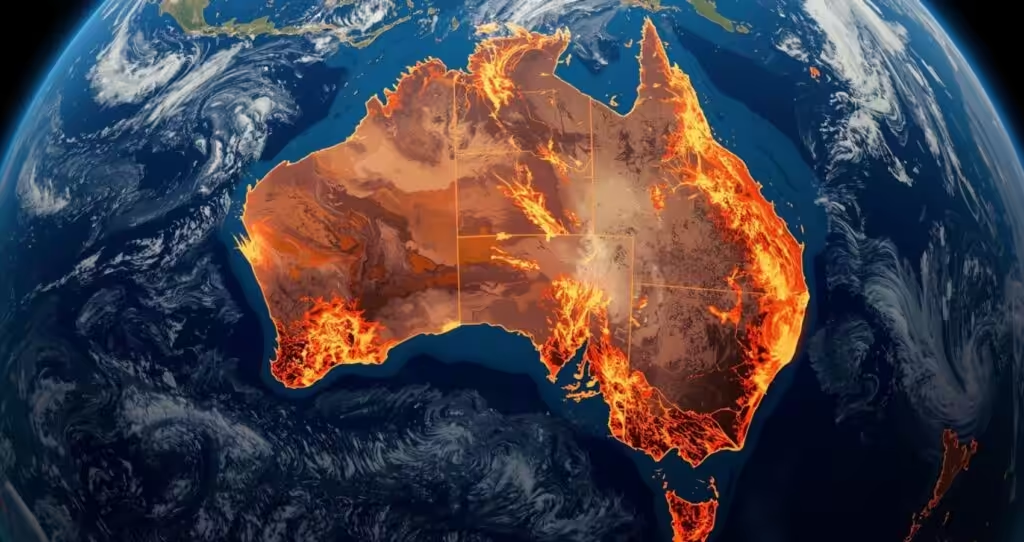
Australia might be in for a warmer and drier second half of the year, with climate models increasingly indicating the development of an El Niño event in the near future.
The Bureau of Meteorology announced on 31 March that the 2025 La Niña event has officially ended, concluding an event in which there has been extensive above average rainfall and flooding across various states.
Climate indicators have shown ENSO neutral conditions, but all climate models show the warming of the tropical Pacific will persist with some even indicating the development of an El Niño event as early as May.
The likelihood of an El Niño event developing in the second half of 2026 has been estimated at above 90% by the Bureau’s model, while international forecasters have estimated it at 50% to 60%.
Also Read: Former Trump allies demand end to Iran war as MAGA movement splinters
Some have even gone as high as 80%, with Washington Post meteorologist Ben Noll estimating there is an 80% chance of a strong event developing by August, according to the European Centre model.
Experts have emphasized, however, that forecasts at this time of the year have additional uncertainty.
This is because of the so called ‘autumn predictability barrier,’ which affects the accuracy of ENSO forecasts at this time of the year. Accuracy is expected to improve as winter approaches.
This phenomenon is expected to bring below average rainfall, above average temperatures, increased bushfire risks and increased instances of frost.
Some models have also forecasted the possibility of a positive Indian Ocean Dipole event occurring at the same time as El Niño, which has previously led to severe dry spells, especially in the east.
The timing of this event is of great concern. In southern Australia, there is already a drought in full swing since 2023.
Melbourne’s water storage is at 70%, and it has the potential to fall even further.
To add to this, the early 2026 bushfire season has already been one of the most dangerous since Black Summer, with more than 400,000 hectares of land burned in Victoria.
An event like El Niño would add to the problems faced in the country.
Linden Ashcroft has said that at the moment, the event is being forecast based on ocean conditions, and it has not yet coupled with atmospheric conditions.
He pointed out that while the occurrence of El Niño increases the likelihood of a hot and dry spring and summer in eastern Australia, the intensity of the event itself does not necessarily portend a severe event.
What is agreed upon, however, is the fact that a strong event will certainly drive up the temperature globally, and the impact will be felt until 2027.
The picture will become clearer in the coming autumn as the predictability barrier is passed.
For now, the message remains clear: “Stay informed, plan ahead but don’t make big decisions based on just one forecast.”