
Australian families are copping a financial blow from rising petrol prices, which economists claim is the equivalent of three interest rate rises, with the financial pain coming on top of two actual rate rises by the Reserve Bank this year.
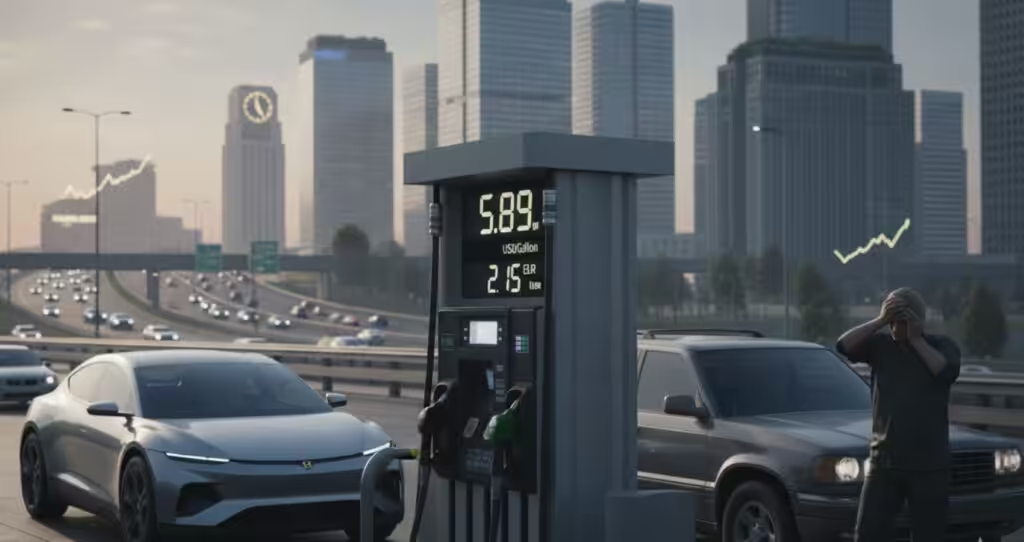
Unleaded petrol prices have risen from $1.80 a litre before the US-led strikes on Iran at the end of February to $2.30 a litre in most capital cities.
This represents a rise of 27% or an extra $1,430 a year for a family that uses a litre of petrol once a week, just for petrol never mind other petrol using appliances.
Diesel prices have risen even higher, with the terminal gate price for diesel in Melbourne rising 57.5% or from $1.65 a litre to $2.60 a litre.
The rise in petrol prices is due to a blockade by Iran of the Strait of Hormuz, which prevents crude oil from Gulf countries reaching Asian refineries, which supply 80% of Australia’s petrol, diesel and jet fuel supplies.
Up to three interest rate increases are currently being priced in by financial markets for 2026, which would put mortgage costs at their highest point in fifteen years.
This year, the RBA has already increased the cash rate twice, the most recent increase to 4.1% was approved by a slim 5 to 4 vote.
According to calculations, rising rates and inflation have caused the average mortgaged household to pay an additional $330 per month.
However, not everyone is of the opinion that the central bank is taking the right approach.
In fact, Matt Grudnoff, Senior Economist at The Australia Institute, was quite candid in his comments on the central bank’s decision in March.
According to him, “Inflation driven by a global supply shock is not something that can be addressed by raising domestic interest rates.”
The higher cost of petrol and diesel means people have less to spend on other things, but it also means people are sending more of their money overseas.
The squeeze on spending
The Treasury believes that sustained high oil prices could shave off as much as 0.6% from GDP growth.
The numbers for consumers are quite daunting. “Every extra $40 people are paying at the bowser is $40 less for food, entertainment, or paying off debt.”
Furthermore, Two interest rate rises in eight weeks, and weaker growth in discretionary spending in the second half of calendar year 2026 are all but assured.
AMP Chief Economist Shane Oliver called it a “double whammy or triple whammy” for consumers.
He also warned, “If the Strait of Hormuz is shut for a long time, the risk of recession rises materially.”
According to the most recent data released today by the Australian Bureau of Statistics, trimmed mean inflation remained at 3.3% and the annual CPI was 3.7% for the year ending in February, a minor improvement from 3.8% in January.
He also said that the markets began to price this in after Brent crude rose to US$120 per barrel, levels not seen since the Russian invasion of Ukraine in 2022.
The RBA board will meet again on the 4th and 5th of May.
The Governor, Michele Bullock, has said that it is too early to determine the full impact of the Middle East conflict on the economy, but has also indicated that the bank would act if inflation was at risk of becoming entrenched.
For millions of Australians, who are already living on the edge, the next few months will be the ultimate test of their finances.