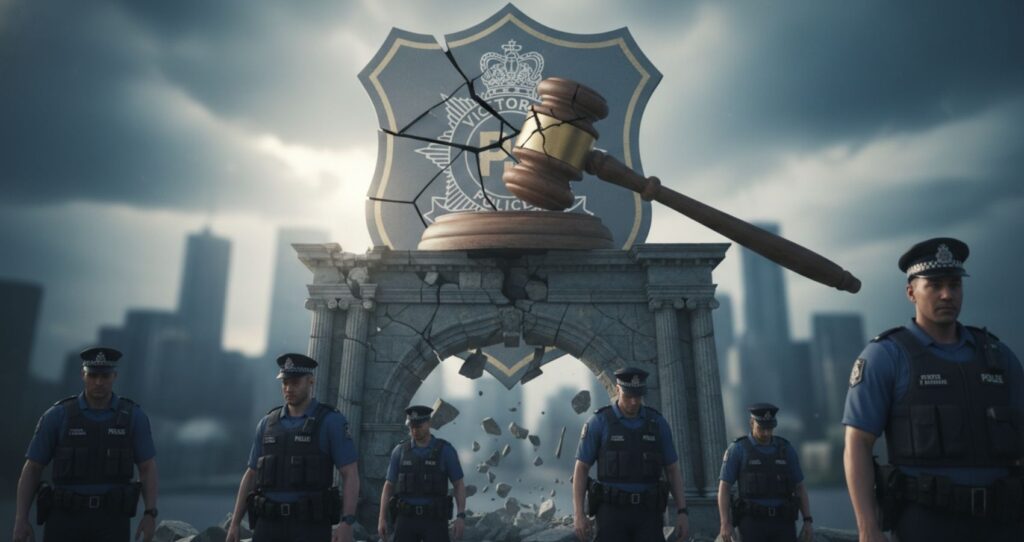

A Federal Court ruling has found Victoria Police acted unlawfully when it extended a designated stop and search area across Melbourne’s CBD and surrounding streets for months in a decision likely to shape how police use the powers around major events and protests.
Justice Elizabeth Bennett declared the designation invalid and unlawful finding the senior officer who signed it off applied the wrong legal test under Victoria’s Control of Weapons Act and failed to properly consider privacy rights protected by the Victorian Charter of Human Rights and Responsibilities.
The designated area which was named “Melbourne CBD and Vicinity” was created on or around November 25, 2025 and it was meant to last from November 30, 2025 to May 29, 2026 nearly the six month maximum permitted for that kind of declaration.
Later on, it was changed to expire early on January 9, 2026.
Within a designated area, police and protective services officers can use additional search powers including searching people and belongings without a warrant and using a face covering provision that can require someone to remove a face covering in defined circumstances or leave the area if they refuse.
The case was brought by protest organiser Tarneen Onus Browne and performance artist Benny Zable with Human Rights Law Centre support.
A third applicant David Hack was added after he was searched while travelling to a rally in the designated area in early December.
Justice Bennett found the legal threshold for a long designation is not a broad reasonably appropriate test.
She said necessary in the key provision carries a meaning closer to essential and concluded the assistant commissioner’s approach was erroneous, meaning he did not apply the correct statutory criteria or reach the required state of satisfaction.
The judgment details how the decision was made after the assistant commissioner received a document pack at about 9am on 24 November 2025, reviewed it for roughly two hours, and decided to make the declaration that morning.
Justice Bennett found the decision maker did not properly engage with the right to privacy in section 13 even though the search powers and face covering provision can interfere with personal privacy by exposing identity and increasing the likelihood of being searched.
She said the lack of any engagement with privacy in the assistant commissioner’s account of his reasoning showed the impact was not considered, which was enough to establish a breach of the Charter’s proper consideration obligation.
The applicants also ran a constitutional challenge to the face covering provision, arguing it impermissibly burdened political communication and protest activity.
Justice Bennett rejected that challenge, finding section 10KA(1) did not contravene the implied freedom of political communication.
After the ruling, Human Rights Law Centre legal director Sarah Schwartz said the case highlighted problems in police decision making around designated areas while Ms Onus Browne described it as a huge win for people planning to rally on 26 January.
Victoria Police said it respected the court’s decision and would consider the findings.
A spokesperson also said there were no stop and search declarations planned for the Melbourne CBD on Australia Day because there was no intelligence suggesting a heightened risk of violence.
Justice Bennett otherwise dismissed the application and made no order as to costs.