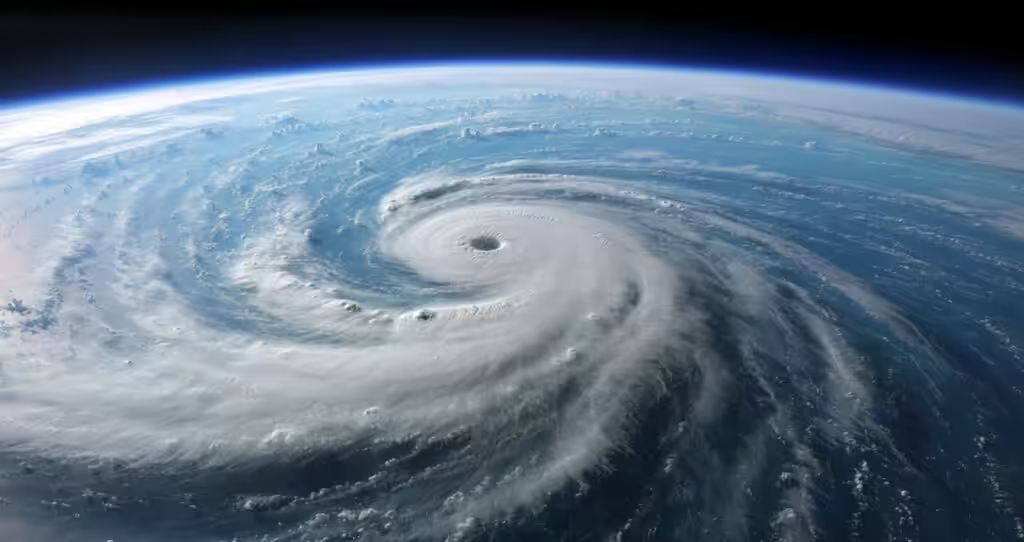

Satellite images have shown the enormity of Tropical Cyclone Narelle as it has created a rare path of destruction across Australia, landing in three different states and territories within a single week.
Tropical Cyclone Narelle was first spotted in the Coral Sea on 16 March 2026 before rapidly developing as it was heading towards the Queensland coast.
On 19 March 2026, images captured by the NASA/NOAA satellite’s VIIRS instrument aboard the NOAA 21 satellite showed the enormity of the cyclone’s.
Cloud bands spinning across the Coral Sea, resembling a tightly wrapped vortex that resembled a large white pinwheel stamped across the sea from hundreds of kilometres above the Earth’s surface.
The sea surface temperature along the path of the tropical cyclone ranged from 0.5 to 1.0 °C above average, which assisted in the rapid development of the cyclone.
It eventually became a Category 5 tropical cyclone on the Australian tropical cyclone intensity scale, with winds reaching a maximum of 225 km/h, before it made landfall in Queensland on 20 March.
What transpired next was what made Narelle so unique and visually arresting from orbit.
It is incredibly uncommon for a single storm to affect three Australian jurisdictions.
The cyclone swept across the Top End before reemerging on March 21 to hit the Northern Territory and Western Australia.
A storm that refused to die
The Earth data platform, run by NASA, had posted an animated image using brightness temperature data from NOAA 20, showing the structure of Narelle in dark purple colors as it moved across the continent from 19th to 27th March.
The images tracked its movement from the warm waters of the Coral Sea, through the Gulf of Carpentaria and out across the Indian Ocean off the Pilbara coast of Western Australia.
The storm had weakened as it crossed the land but strengthened again as it passed through the eastern Indian Ocean, reaching category 3 strength on the 25th of March before intensifying further to category 4 as it approached the North West Cape region of Western Australia.
The storm finally made landfall on the southern side of Coral Bay, Western Australia, approximately 9:30 am on the 27th of March, as a category 3 storm, with gusts reaching up to 195 kilometers per hour.
During Narelle’s journey, large portions of the Northern Territory received more than 100 millimeters of rain, exacerbating an already dire wet season.
The satellite image of Narelle provides more than just visual interest.
The satellite, along with the VIIRS satellite, was able to track not only the form but also the rainfall intensity of the cyclone in real time, using the satellite data from the NASA satellite, the Global Precipitation Measurement satellite.
As of late on the 27th of March, the cyclone had started to turn southerly, weakening rapidly as it moved into the land east of Perth changing into a mid latitude cyclone.
The satellite images, however will be remembered for the power and the relentlessness of one tropical cyclone.