
Australia’s fuel security is currently undergoing its toughest challenge in decades with the country’s overwhelming reliance on Asian refineries.
Meeting a severe challenge from a global oil supply crisis that has left regional towns running out of diesel and forced the Federal Government to draw on emergency supplies.
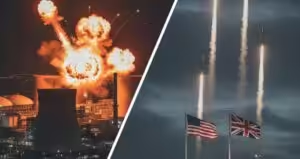
The crisis began with the escalation of the military conflict between the US and Israel and Iran.
This led to the closure of the Strait of Hormuz, a critical waterway for one fifth of the world’s oil supplies.
Escalation of this crisis saw crude oil prices climb past $100 a barrel. This crisis is now spreading to all parts of the Asia Pacific region.
Also Read: Why $2.20 a litre is doing more for EV sales than years of government policy
Country gets 90% of its oil supplies from overseas and this oil is imported in refined form from countries like South Korea, Singapore, Malaysia and Taiwan.
However, these countries import their crude oil from the Middle East and this oil supply passes through the Strait of Hormuz.
Defence research experts have named this a ‘two steps upstream’ problem. This problem cannot be solved by alternative routes because these refineries that supply oil to Australia also need this oil supply.
Australia’s Asian suppliers are now rushing to diversify their crude sources, looking to Africa, Latin America and Russia, according to the most recent government briefing.
However, due to the worldwide scope of the price shock, alternatives are significantly more expensive.
South Korea has capped fuel prices for the first time in almost thirty years and Japan has promised to release a record 80 million barrels from its national reserves.
Domestically, the Energy Minister, Chris Bowen temporarily eased fuel quality requirements, allowing higher sulphur petrol to be imported into the domestic market.
This added approximately 100 million litres of petrol per month. In addition, the Government released up to 762 million litres of petrol and diesel from domestic supplies.
Issue here is that independent distributors in rural areas cannot obtain a supply of fuel. In fact, they have had to shut down their businesses for days.
The fundamental issue is that Australia used to have eight oil refineries. Today, it has only two, supplying less than 20% of the country’s fuel requirements.
Australia is the only member of the International Energy Agency that has failed to meet the mandatory 90 day fuel reserve requirement since 2012.
Australia’s long term bet on affordable, dependable imports is being put to the test in real time as the Strait of Hormuz remains closed and Asian refineries deal with growing feedstock uncertainty.