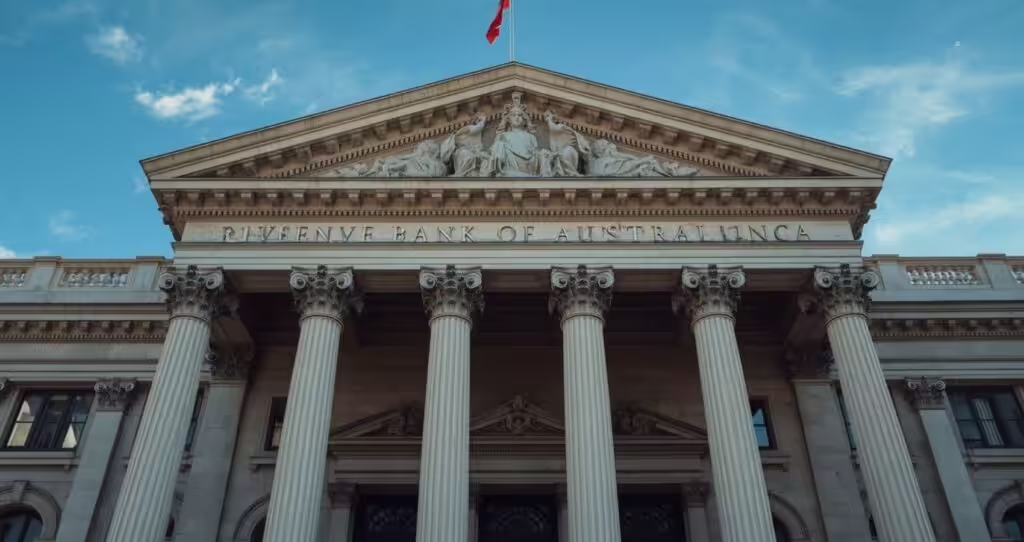

National Australia Bank has revised its projection regarding when the RBA will make its next interest rate hike following a lower than expected jobs report that cast doubt about the necessity of an imminent rate hike next month.
Prior to the jobs report, NAB had been projecting that the RBA would implement a rate hike in June.
However, the bank now anticipates that the RBA will delay any interest rate hikes until August.
This revision is based on the latest official Labour Force figures revealing an unemployment rate of 4.5%, which represents a 0.2% point increase from the previous month and marks the highest rate since the beginning of the present tightening cycle.
Based on the report, the seasonally adjusted employment dropped by 18,600 people to reach 14.74 million, whereas unemployment increased by 33,000 people to hit 714,000.
Economy News: Casual roles climb as fulltime hiring weakens under economic strain
The results were somewhat contrary to the projections provided by the RBA in its monetary policy statement published in early May.
According to the RBA, the average jobless rate is set to stand at 4.2% in June and will be around 4.3% at the end of the year.
NAB senior economist Taylor Nugent said the April result challenged that view and highlighted rising risks on the employment side of the central bank’s mandate.
“This softer print takes the pressure off the RBA to act quickly on inflation,” he said.
The balance of risks has shifted in favour of the board’s characterisation that they have some ‘space’ to monitor incoming data for both inflation and activity impacts due to higher oil prices and uncertainty coming out of the Middle East.
This is not to say that all interpretations of the charts were negative.
Trend analysis, which ironed out the volatility in monthly figures, showed a rise in employment by 22,100, while unemployment remained at 4.3%.
The number of hours worked also climbed 15.8 million during the month.
Sean Crick, director of the Bureau’s labour statistics, revealed that hours worked per individual went up 0.9% despite a reduction in headline employment.
Also Read: Founders under 40 slam Albanese’s CGT overhaul as ‘aspiration ambush’
“Softening demand will be welcome news for the RBA. Nevertheless, the increase in hours worked shows that the labour market is slowing down less than what the headline numbers suggest,” stated Anders Magnusson, chief economist at BDO.
Despite this, the major banks disagree on future interest rates. Westpac, alongside National Australia Bank, forecasts an increase in August.
On the other hand, Commonwealth Bank of Australia and ANZ Bank believe that the cash rate has reached its peak of 4.35%.
Financial markets responded swiftly to the release.
The chance of a rate rise at the June meeting fell to about 3% from 13% before the figures landed, easing the immediate threat of back to back increases to mortgage holders.