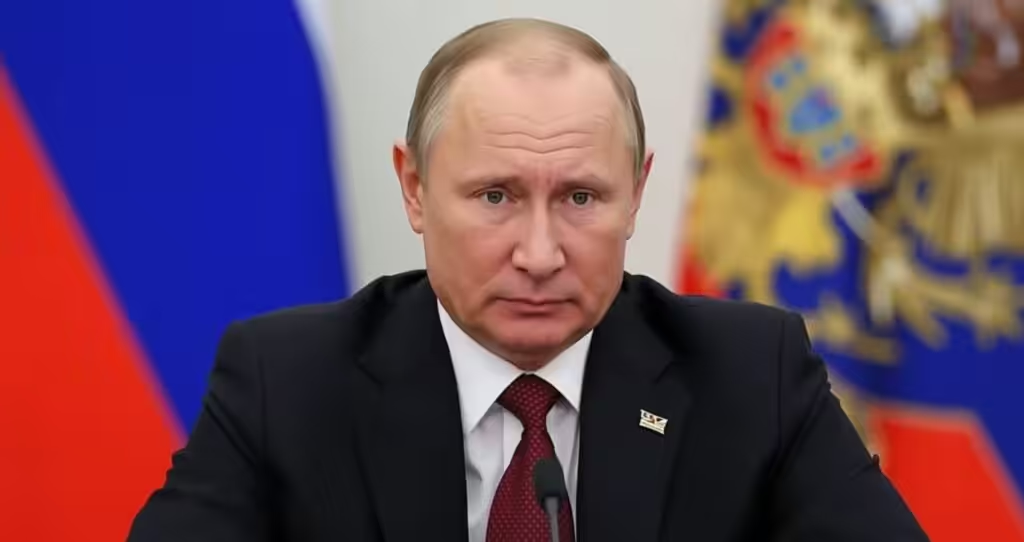
Vladimir Putin landed in Beijing on Tuesday for a two day state visit, thus becoming the second global leader in just a week to seek favours from Chinese President Xi Jinping.
Despite the fact that Donald Trump decided to put off military operations against Iran in exchange for further talks.
Putin’s official visit to China, which is to take place on 19 and 20 May, has been announced by both the Kremlin and Beijing and comes on the occasion of the 25th anniversary of the Treaty of Good Neighbourliness, Friendship and Cooperation.
More than 40 agreements are to be signed during his visit, according to Russian officials.
The visit comes right after the grand welcome ceremony China had organized for the American President only days ago, thus making the unprecedented act of welcoming the leaders of two biggest rivals in the world one after another.
Among the list of commercial agreements achieved during Trump’s visit to China were a $17 billion annual purchase of agricultural goods until 2028, 200 aircraft order from Boeing and a visit to Washington from Xi in September.
In contrast, the revelation about Putin’s trip to China is being portrayed as normal business between long-time partners, and not much fuss is made about it.
Before Putin left for China, it was made clear that Moscow was nearing a “serious” deal with Beijing regarding energy issues.
The long debated Power of Siberia 2 gas pipeline project would be among those discussed during Putin’s trip to China.
Revenue from exports of cheap oil to China have become more important for Russia due to economic sanctions from the West over Russia’s invasion of Ukraine.
Meanwhile, while Beijing juggles with its two guests, Washington’s focus shifts once again to the Middle East.
Trump told journalists at the White House: “There seems to be a very good chance that they can work something out.
It followed the statement from Tehran that it had responded to a new offer from Washington meant to bring an end to the war waged against Iran and its allies on February 28 by both the United States and Israel.
The ceasefire announced on April 8 seemed fragile as Trump himself said it was on “life support” but later changed his mind.
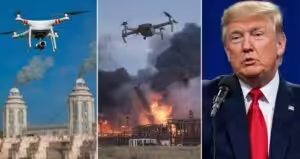
War News: Drones strike UAE nuclear plant and breach Saudi airspace as Trump warns Iran
However, Trump threatened that in case Iran refused the terms preventing the country from developing a nuclear bomb, the US forces would be ready to conduct a “full, large scale assault.”
Among those calling upon Trump to launch air strikes was Republican Senator Lindsey Graham.
These two events emphasize China’s rising diplomatic significance.
In recent years, both Russia and Iran have been seeking assistance from China in their efforts to lift the economic sanctions imposed on them, while Trump’s administration has been trying to persuade Xi to prevent Iran from building up nuclear weapons.
The message Putin will convey to China this week will be more concise: any rapprochement between the US and China should not undermine the Russia China relationship.