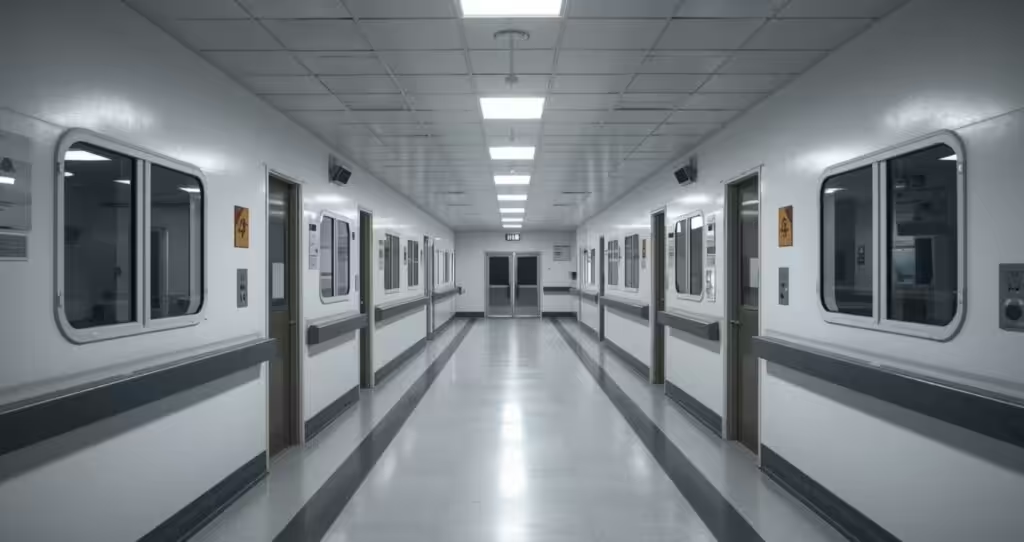

No visitors. No mingling. Personal rooms with their own air filters.
For the U.S. tourists who have been evacuated from the MV Hondius cruise ship where three other passengers have passed away due to Hantavirus, Nebraska’s National Quarantine Unit seems like a far cry from their initial vacation plans.
According to the press, sixteen passengers of the cruise ship have landed at the National Quarantine Unit based at the University of Nebraska Medical Center, Omaha, on Monday.
It must be noted that the facility is unique for the United States as it is the only federally funded quarantine unit within the country that had been designed and built specifically for such contingencies, although few would have ever expected to use it so quickly after its last major use.
The unit was built and opened at the end of 2019 with funds provided by the U.S. Department of Health and Human Services, amounting to around US$20 million.
In just two months, it went into action when the novel coronavirus outbreak began.
Also Read: Australia warns travellers about deadly virus in Argentina after cruise ship outbreak
Now, six years later history is repeated down the same corridors, only this time it’s a very different pathogen.
More hotel than hospital
“The space is much closer to a hotel than a patient care ward,” said the medical director of the quarantine unit Angela Hewlett.
It features 20 single occupancy rooms, each with its own negative air pressure system and HEPA filtration.
There’s gym equipment, Wi-Fi and the ability to make phone and video calls, but that’s about as comfortable as it gets.
No visitors are allowed except medical staff, and people are not free to leave their rooms to mingle with each other.
The Nebraska Biocontainment Unit, which exists close by in the same campus, acts like an intensive care ward for very dangerous diseases with an air handling system of its own.
So far, one of the repatriated individuals who tested only mildly positive for the Andes strain of hantavirus has been moved here, although it is reported that this person still shows no symptoms.
There is some history to the biocontainment unit in Omaha that backs up the assurance of its personnel.
The passengers are not, technically, being held under mandatory quarantine.
The officials say that people are not required by law to remain on site for the entire 42 day period, although this is still a matter of some debate among public health officials.
What makes this particular strain of the virus alarming to epidemiologists is that it is the only strain of the hantavirus capable of human to human transmission.
Regardless, WHO has been adamant about reassuring the public that the danger is relatively low.
The first symptoms appeared in a Dutch passenger on 11 April and he passed away soon afterward.
Another passenger has also passed away. According to WHO figures released on 8 May, there have been eight cases, including six laboratory confirmed cases, resulting in three deaths.
The crucial difference this time is that health officials seem determined to move fast, applying lessons learned from the chaotic early weeks of COVID 19 to provide a more coordinated global response.
It is not yet known if the National Quarantine Unit will have to keep its guests for the full six weeks.
For now, the facility born in one pandemic era is set to prove its worth in another crisis, however contained that crisis may ultimately prove to be.