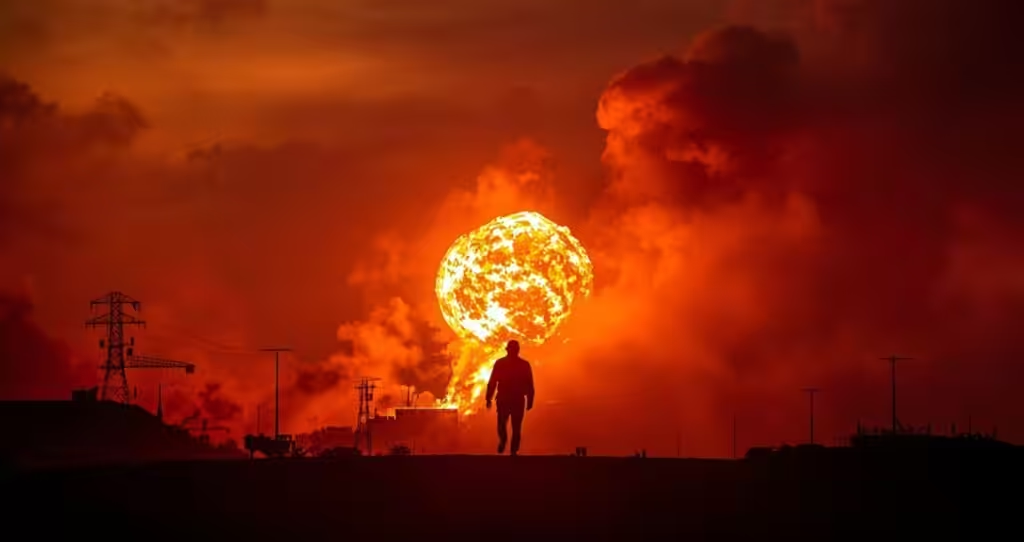
The year 2026 sees the global order experiencing more instability compared to the situation during the Cold War period.
Several ongoing conflicts can be observed today, nuclear states are engaged in military conflicts and even the symbol of the closeness between humanity and disaster is at an all time high.
However, even the most reliable experts shy away from the assumption that a new world war could happen anytime soon.
January saw the movement of the Bulletin of the Atomic Scientists’ Doomsday Clock by 85 seconds before midnight, representing the closest approach to destruction in the organization’s 80 year long history.
Factors influencing this shift included increased risk related to nuclear weapons, lack of regulation in artificial intelligence, biological security issues and the continuous struggle with the climate crisis.
The flashpoints that make that assessment possible are spread out over many continents.
The war in Ukraine has been going on for four years and is still going on.
It involves a nuclear armed country, and NATO’s role in providing weapons and intelligence keeps the risk of escalation high.
There are more than 56 active wars going on around the world right now, including a direct military conflict between Iran and Israel and civil wars in Sudan, Myanmar, and the Democratic Republic of the Congo.
Taiwan Strait continues to be an important source of danger.
Traditionally, the confrontation between the USA and China with Taiwan as the central point has always been considered the main source of possible threats.
Council on Foreign Relations included thirty conflict scenarios divided into three categories depending on their significance.
Six of the eight highest rated threats had something to do with Israel, while the war in Sudan was recognized as the most probable to continue.
One of the most surprising results was that of the direct military intervention of the USA in Venezuela, which received one of the highest ratings.
Why most experts still say “not yet”
Despite the alarm, most analysts still think that a major power will not choose to start a global war.
Nuclear deterrence, economic interdependence, and diplomatic channels are still ways to keep conflicts from happening, even though the threat of accidental escalation is still a big worry.
Even though there are viral predictions going around on social media, credible forecasts do not support a set date for the start of a global war.
Also Read: Artemis II astronauts splash down in Pacific Ocean after record breaking lunar voyage
Some authors point out that the scenario for an upcoming global war can be quite different from the two World Wars of the last century since it will likely involve cyber attacks on key infrastructure, economic warfare and limited strikes, but not mobilization on a continental scale..
So, the true answer to the above question is that there is no one that can give you an exact answer right now.
We only know for sure that there are fewer guardrails left in place from the Cold War era and the number of ongoing conflicts is higher than it used to be and chances for misjudgment are lower.