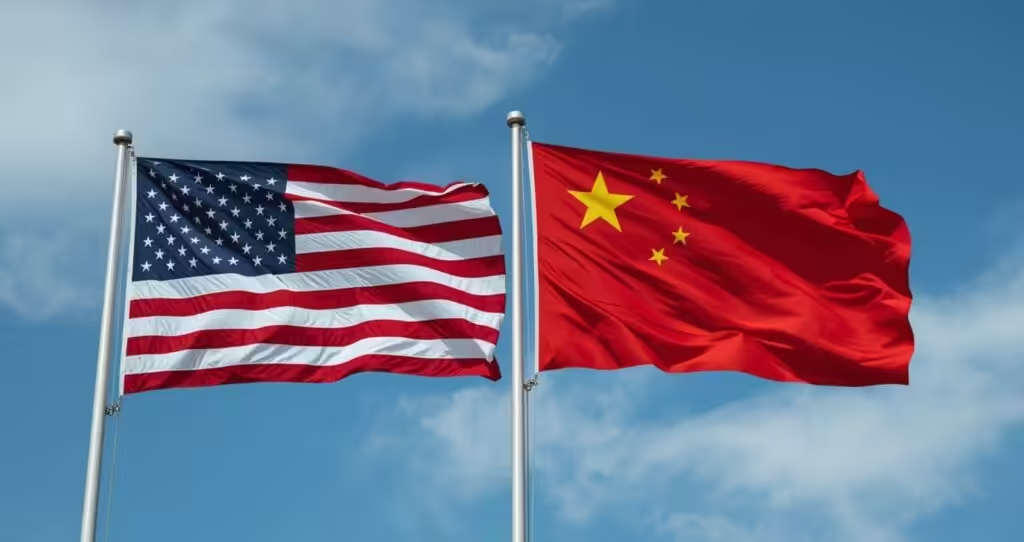

However, the two week long ceasefire between the US and Iran, mediated by Pakistan and backed heavily by China from the background, seems to be hanging by a thread just a few days into its existence due to three different crises.
The first crisis is Israel’s constant bombardment of Lebanon while the second one is the total blockade of the Strait of Hormuz. On top of all these, a controversy over the scope of the ceasefire has emerged.
Speaking in a cabinet meeting on Thursday, Israeli Prime Minister Benjamin Netanyahu instructed his ministers to start talking directly with Lebanon while acknowledging their repeated appeals.
Israel’s air strikes on Wednesday marked the most deadly attacks since the beginning of the conflict on 2 March.
More than 300 people were killed and 1,000 others wounded in the raids that struck Beirut and elsewhere in Lebanon.
The strikes reportedly targeted more than 100 Hezbollah targets simultaneously within 10 minutes.
There have been even more attacks on Thursday as the Israeli army said it had killed an advisor of Hezbollah’s leader, Naim Qassem.
The violence has messed up the larger peace process.
Mohammad Bagher Ghalibaf, the speaker of Iran’s parliament, said that negotiations can’t start until there is a ceasefire in Lebanon and Iran’s frozen assets are released.
The core difference between the parties comes from the misunderstanding of what was decided at the talks
Washington and Israel claim that Lebanon is not included in the ceasefire deal, while Iran and Pakistan who act as mediators in the negotiations, believe otherwise.
This gap has only increased amid the continued bombing.
Hormuz: open in name, closed in practice
Even though the Strait of Hormuz is the point through which almost 20% of global oil and gas trade passes in normal times, it still effectively remains closed.
No more than two tankers carrying oil and gas have managed to pass through the water route following the announcement of the ceasefire, according to data provided by analytical platform.
IRGC linked Fars News Agency claimed Wednesday that Iran closed the strait as a reaction to Israel’s air strikes against Lebanon just hours before two tankers passed through it.
The White House described the move as “completely unacceptable” and ordered Iran to reopen it.
Iran is said to be charging ships up to US$2 million per trip, which can be paid in Chinese yuan or cryptocurrency to avoid the dollar based financial system.
Shipping industry experts caution that it may take weeks, perhaps even months, for the strait to resume normal traffic, with over 400 oil carrying tankers and several gas carriers waiting outside the Gulf for instructions to sail.
The implications are already being felt worldwide. In parts of Europe and Asia, spot crude prices hit all time highs of around US$150 per barrel, whereas U.S. diesel prices were within 13 cents of their highest ever levels on Thursday.
But even the truce itself owes much to China’s influence. According to Iranian sources, an intense push by Beijing towards the last moment helped Tehran agree to the truce.
China’s foreign minister Wang Yi conducted 26 phone conversations with his counterparts from concerned nations and China and Pakistan offered a five point plan for peace in late March.
War News: Vance Just Told Iran to Back Off and Now He Is Flying to Pakistan
However, Beijing has avoided making exaggerated claims about its influence, limiting themselves to stating that “China made active efforts” for resolving the conflict.
The talks have been scheduled to take place in Islamabad on Saturday, where the vice president of the United States, JD Vance will head the delegation against Ghalibaf of Iran.
Meanwhile, Pakistan is endeavoring to include Lebanon and Yemen into the wider scope of the ongoing negotiations.
Already a senior Hezbollah official has ruled out the possibility of any talks between Israel and Lebanon on the basis that the Beirut government cannot speak for the movement.