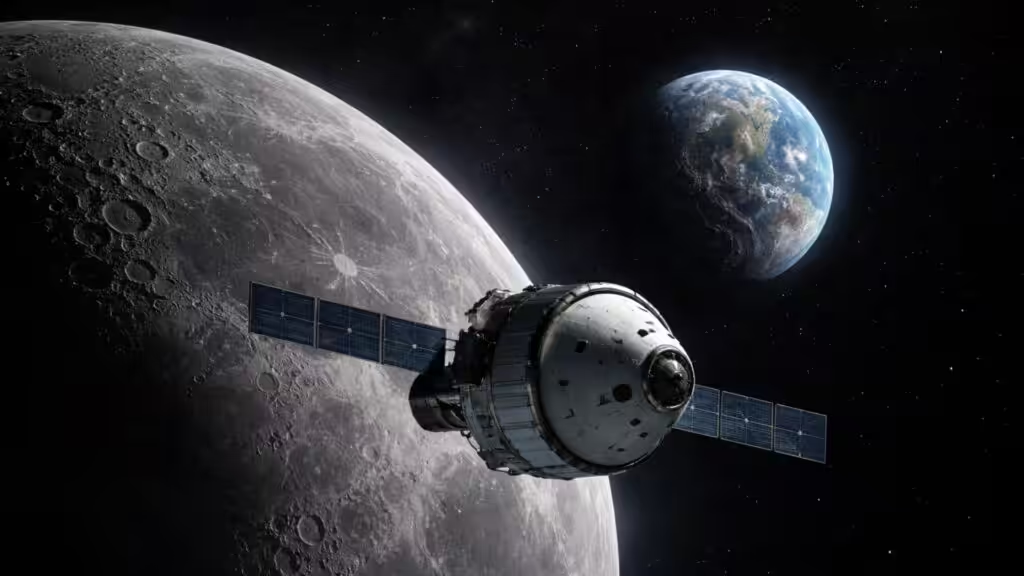

Four astronauts aboard NASA’s Orion spacecraft flew around the Moon on Monday, completing the first crewed lunar flyby since Apollo 17 in 1972 and travelling further from Earth than any humans in history.
At 12:56 pm US Central time, NASA astronauts Reid Wiseman, Victor Glover, and Christina Koch, along with Canadian Space Agency astronaut Jeremy Hansen, passed 248,655 miles from Earth, eclipsing the distance record held by the Apollo 13 crew since 1970.
The crew eventually reached a maximum distance of roughly 406,773 kilometres, about 6,600 kilometres further into space than any previous human mission.
Orion came within approximately 4,067 miles of the lunar surface during the flyby. The crew spent seven hours conducting observations, photographing features of the Moon’s surface including areas of the far side that no astronaut has directly seen before.
As the spacecraft passed behind the Moon, the astronauts experienced a roughly 40 minute communications blackout with mission control.
Canadian astronaut Hansen marked the moment by sharing maple cream cookies with his crewmates.
Weather news: Severe storms and snow forecast as cold front barrels toward southeast Australia.
The spacecraft also passed through a solar eclipse lasting about an hour, with the Moon blocking the Sun from the crew’s perspective.
The astronauts used the opportunity to observe the solar corona glowing around the lunar edge and to watch for meteoroid impacts on the surface.
Commander Wiseman, a former International Space Station resident, reflected on the scale of the journey. “On the International Space Station, we’re 250 nautical miles up,” Wiseman said. “And we are dealing with numbers that are 250,000 miles.”
The mission launched on 1 April from Kennedy Space Centre in Florida atop NASA’s Space Launch System rocket, carrying four crew members on a 10 day trip.
It is the second flight in the Artemis programme, following the uncrewed Artemis I test in late 2022, and is designed to verify that Orion’s life support, navigation, and propulsion systems are ready for future missions that will land astronauts on the lunar surface.
War News: Ben Roberts Smith arrested at Sydney airport over alleged Afghan war crimes.
On Tuesday, Orion is expected to exit the Moon’s gravitational sphere of influence and perform its first return trajectory burn.
The crew will also place a call to astronauts aboard the International Space Station and debrief with NASA science officials about their lunar observations.
Splashdown is scheduled for approximately 8:07 pm US Eastern time on Friday, 10 April, in the Pacific Ocean near San Diego.
The crew will be recovered by helicopter and taken aboard the USS John P. Murtha for medical checks before flying to NASA’s Johnson Space Centre in Houston.