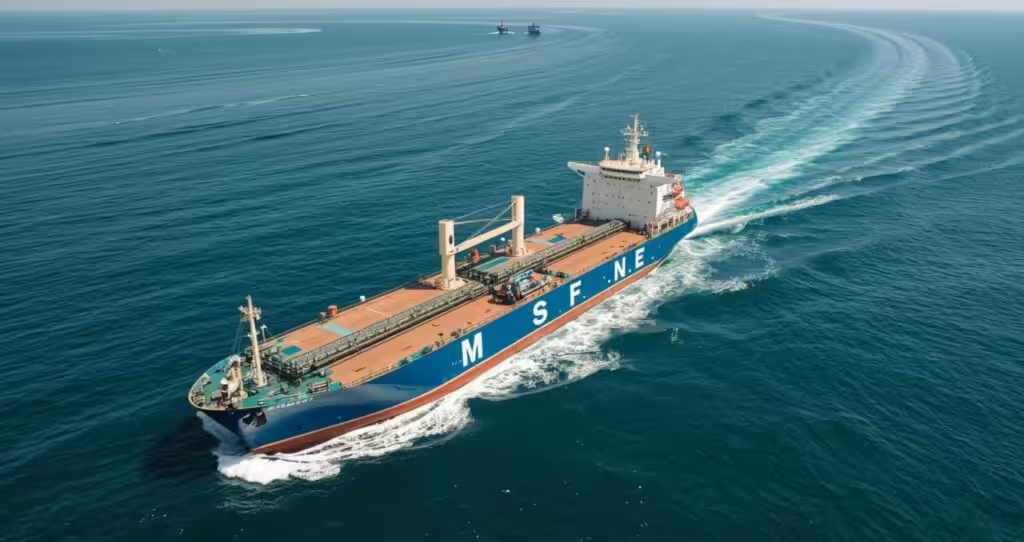

Tehran has created a narrow corridor through the most important oil bottleneck in the world for only a few countries it perceives to be allies.
This is an indication of the increasing control that Iran is gaining over international energy supplies, despite the ongoing five week conflict with the U.S. and Israel.
Foreign minister of Iran, Seyed Abbas Araghchi, declared that only vessels from five different countries were allowed to navigate through the Strait of Hormuz: China, Russia, India, Iraq and Pakistan.
It was a significant departure from Iran’s earlier decision, wherein ships attempting to sail through the waterway were threatened with destruction by the Islamic Revolutionary Guard Corps back in early March.
It is worth noting that the strait carries approximately 20% of all international oil shipments.
As expected, the price of Brent crude climbed above US$100 per barrel immediately after the blockage, reaching a peak of US$126, considering its previous average of US$65.
China is the biggest of the five approved countries.
Beijing gets 45% of its oil through the strait,and as soon as the blockade started, it started asking Tehran for access.
At least three ships linked to China turned around quickly near Larak Island late last week after being warned by the IRGC Navy.
This shows that the arrangements for safe passage are still fragile and depend on the goodwill of other countries, even those that Tehran sees as friendly.
A de facto toll booth
Iran has covertly set up a shipping route north of Larak Island where the IRGC, along with port officials, screens vessels before allowing them access.
According to Iran International, one of Iran’s representatives admitted to the practice, noting that vessels had to pay as much as $2 million in tolls to navigate the strait.
Legal experts have criticized Iran’s attempt to extort fees from vessels navigating its waters.
In contrast, India’s approach has yielded better results in opening up the strait to commercial traffic.
New Delhi was able to ensure safe passage for Indian ships without payment or permission for the same and it claims its diplomatic efforts were the best way to clear the strait.
The race for access has now spread to all of Asia.
On Thursday, Araghchi promised the Philippines that ships flying the Philippine flag and Filipino sailors would be able to pass through safely and without any problems.
The blockade is a serious threat to Manila’s energy security because it gets 98% of its crude oil from the Middle East.
Malaysia and Thailand, among other Southeast Asian countries, have also reportedly received assurances from Iran after diplomatic efforts.
It could be a promising turn of events that Iran and Oman are negotiating a protocol to regulate and coordinate traffic through the strait.
For a time, the news appeared to pacify world markets. American equity indexes, which had seen a steep drop, rebounded after the news broke, while crude oil prices fell from their peak levels for the day.
Also Read: Pentagon ousts Army’s top general as 40 nation coalition charts path to reopen Strait of Hormuz
Over 2,000 ships are currently stuck around the strait. Moreover, the situation does not seem to improve, leaving questions about the implications on global agriculture.
Since the start of the conflict, urea prices have increased 50%, causing concern about its impact on global food production during the northern hemisphere’s planting season.
Iran’s selective reopening serves two purposes for now: it helps the economies of its allies and strengthens Tehran’s main demand in any future agreement.
Iran has said that one of the five things it wants in order to end the war is for other countries to recognize its control over the Strait of Hormuz.