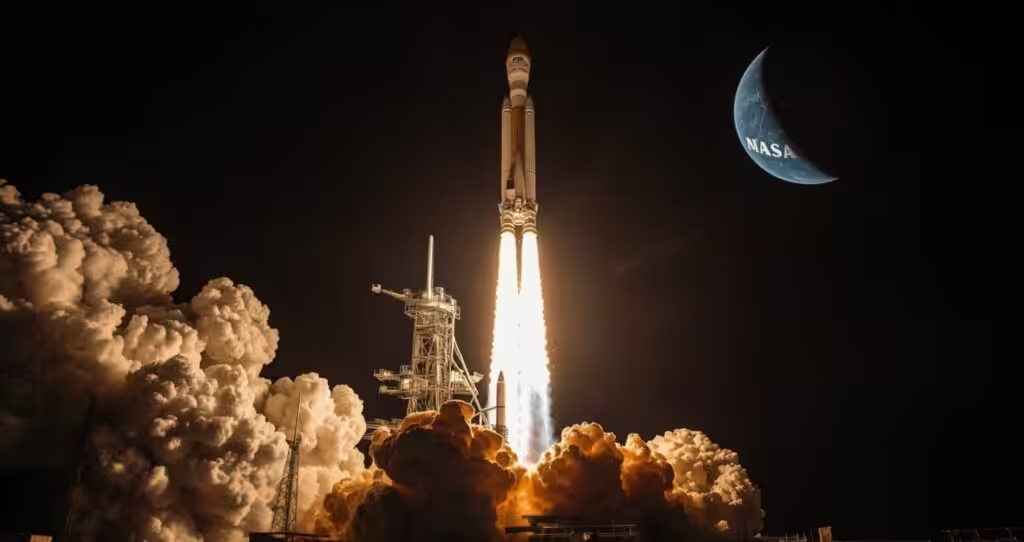

More than half a century after the last crew of astronauts left lunar orbit, four astronauts are once again on their way to the Moon.
The Artemis II mission, undertaken by the United States space agency NASA took off at 6:35 p.m.Eastern Daylight Time on Wednesday from the Kennedy Space Center in Cape Canaveral, Florida.
The mission is a 10 day journey for the four astronauts in the Orion spacecraft, during which they will circle the Moon and return to Earth.
The mighty rocket, which is about 322 feet tall, has the capability to generate 8.8 million pounds of thrust at liftoff as its two solid rocket boosters and four RS 25 engines fire up.
The astronauts on the mission are Reid Wiseman, Victor Glover and Christina Koch of the United States and Jeremy Hansen of the Canadian Space Agency.
This mission marks the first human flight outside of low Earth orbit since the Apollo 17 mission in December 1972.
This mission also marks several firsts, including Glover being the first person of color, Koch being the first woman and Hansen being the first non US citizen to travel outside of low Earth orbit and towards the Moon.
The mission will not include landing on the moon. Artemis II is basically a systems validation flight.
Its main goal is to test the Orion spacecraft’s life support systems, navigation, communication links and overall performance in deep space with a live crew on board.
The spacecraft will stay in high Earth orbit for about a day while the crew shows how to fly it by hand. Then, on Thursday a translunar injection burn will send them on a path toward the Moon.
While on a scheduled multi hour flyby of the Moon on Monday, April 6, the astronauts will take pictures and observe the surface of the Moon, with some astronauts being the first humans to set eyes on the far side of the Moon.
They could travel as far as 4,700 miles past the Moon, possibly breaking the record for the farthest humans have traveled from Earth.
Canadian Prime Minister Mark Carney stated that he called US President Donald Trump to congratulate him on the success of the mission.
In a statement, Carney praised Hansen’s inclusion on the mission, stating that Canada had become just the second country in the world to have an astronaut on a mission to the Moon.
The Artemis programme is part of a series of missions aimed at returning humans to the surface of the Moon for the first time since 1972.
The next mission, Artemis III is scheduled to stay in Earth’s orbit to practice docking with the programme’s commercial lunar landers, developed by SpaceX and Blue Origin.
Also Read: Victoria to ban phones, smartwatches and earbuds in every classroom from 2027
Artemis IV, scheduled for 2028, is currently scheduled as the first potential crewed lunar landing mission.
After the flyby, the Orion spacecraft and its crew will land in the Pacific Ocean after spending about ten days in space.
NASA said that the solar array wings on the spacecraft opened up successfully after launch, which was an important early step in setting it up.
Four astronauts are currently sailing through space on a path that their species hasn’t taken in more than 53 years. The world is watching.