
Iran’s Foreign Minister, Abbas Araghchi, has threatened to inflict severe consequences on Israel after the Israeli Air Force attacked two of the country’s nuclear facilities and two of the largest steel factories in the country on Friday.
According to Iran’s Foreign Minister, the Israeli Air Force attacked two of the country’s largest steel factories, a power plant and civilian nuclear facilities.
In his social media post, the minister accused Israel of coordinating the strikes with the United States.
However, the strikes by the Israeli Air Force did not comply with United States President Donald Trump’s decision to extend the pause in strikes on Iran’s energy infrastructure.
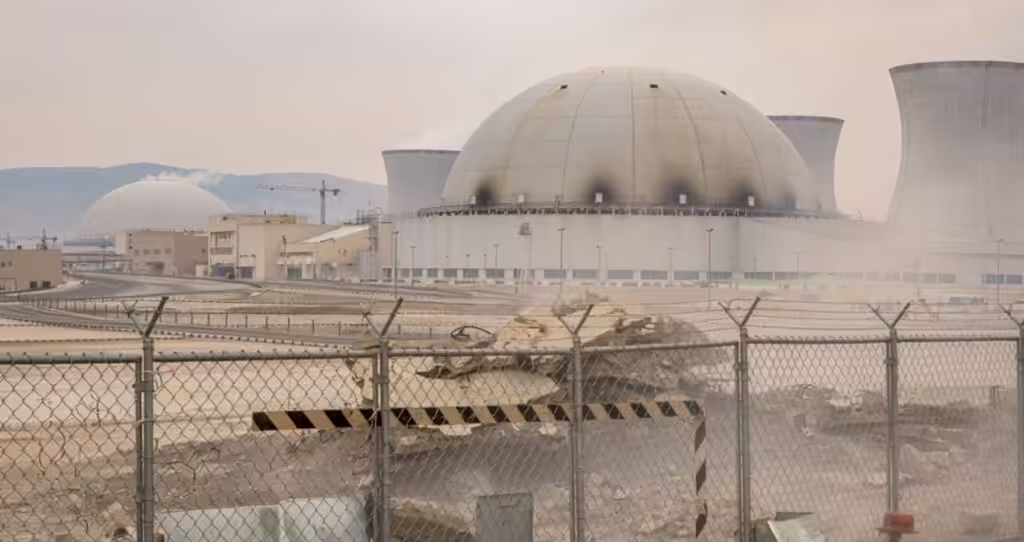
The Israeli Air Force attacked a uranium processing facility in the central part of Iran, in the city of Yazd.
This is a unique facility where raw materials undergo processing for the enrichment of uranium.
The Israeli Air Force also attacked the Khondab Heavy Water Complex in the city of Arak, which is a plutonium production site for the development of nuclear weapons.
Iran’s Atomic Energy Organization acknowledged that both locations were struck, but stated that there was no danger of radioactive contamination or casualties.
Since Israel attacked the Arak facility during operations in June of last year, it has not been operational.
Industrial targets and threats of retaliation
In addition, other Israeli strikes were carried out on Khuzestan Steel, which is near Ahvaz and Mobarakeh Steel, which is based in Isfahan and were identified as being partially owned by the IRGC.
The cost of the damage was estimated to be billions of dollars and was expected to cripple Iran’s steel industry.
The IRGC, on the other hand, threatened to retaliate by asking employees of all industrial plants within the region with American shareholders or ties to Israel to evacuate their places of work immediately.
The list of targets was released by Iran, including steel plants in Israel, Saudi Arabia, the United Arab Emirates, Qatar, Bahrain and Kuwait.
The strikes were carried out just a day after Trump extended a pause on attacks by America on Iran’s energy assets by 10 days, extending the deadline to 6th April.
A reported 15 point American peace proposal was rejected by Araghchi, who stated that Iranian officials had no intention of negotiating it at this time.
Israel Katz, Israel’s defense minister, issued a warning that as long as Iranian missile fire continued, strikes would intensify and spread to new targets.
With oil prices rising to over $110 a barrel globally and stock exchanges facing pressure, Trump is now under increasing pressure to resolve the Iranian blockade of the Strait of Hormuz, through which a fifth of the world’s oil is normally shipped.
Although diplomatic efforts are ongoing through intermediaries such as Pakistan, Turkey and Egypt, the divide between the two parties is huge and the direction of the conflict is becoming unpredictable.