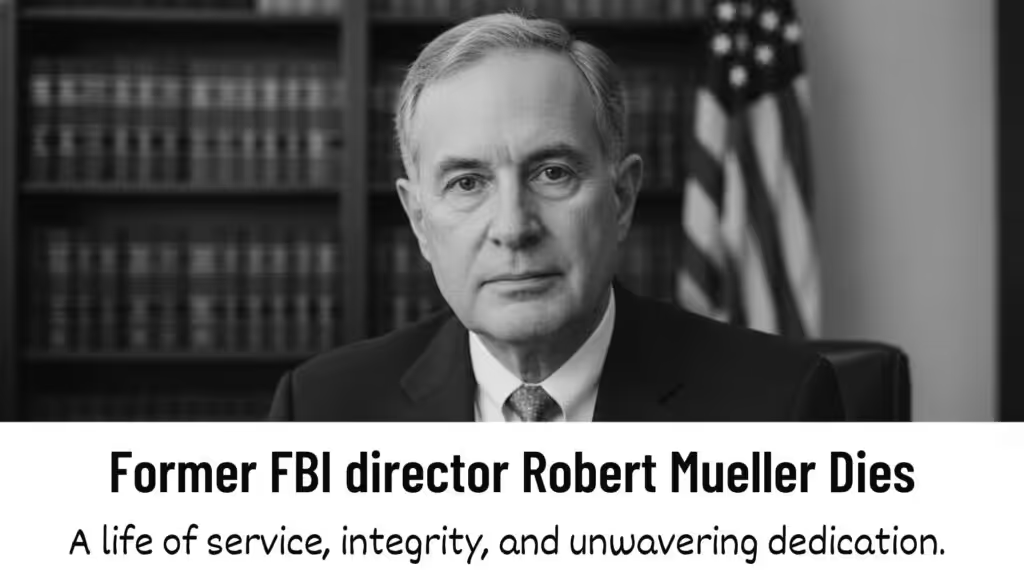

Robert Mueller, the former FBI director who ran one of the most closely watched investigations in US political history, died on Friday in Charlottesville, Virginia. He was 81.
His family confirmed the news on Saturday. “With deep sadness, we are sharing the news that Bob passed away,” the statement said. The family asked that their privacy be respected.
No cause of death was given. Mueller had been diagnosed with Parkinson’s disease in 2021. His family revealed this publicly in August last year.
He is survived by his wife of nearly 60 years, Ann Cabell Standish, their two daughters, and three grandchildren.
Mueller spent six decades in public service across several administrations. He was born in New York City in 1944 and grew up in Philadelphia. He served three years as a Marine in Vietnam, leading a rifle platoon.
He earned a Bronze Star after pulling a fellow soldier from an ambush while under fire. He was later shot in the leg during combat but returned to his unit within three weeks. He also received a Purple Heart.
Here are SA Election Results: South Australian Election Results Confirm Liberal Wipeout and a One Nation Breakthrough
After studying law at the University of Virginia, Mueller joined the Justice Department in 1976. He worked through US attorney offices before heading the FBI’s Criminal Division.
He took over the bureau just one week before the September 11 attacks in 2001 and ran it for 12 years, longer than any director since J. Edgar Hoover.
Under his leadership, the agency went through a major overhaul, moving its main focus from traditional criminal investigations to national security and counter-terrorism.
In May 2017, Deputy Attorney-General Rod Rosenstein named Mueller as special counsel to look into Russian interference in the 2016 presidential election and any possible ties to Donald Trump’s campaign.
The nearly two-year investigation ended with seven guilty pleas and charges against 34 people, including former Trump campaign chairman Paul Manafort and adviser Roger Stone.
Latest News: Why $2.20 a litre is doing more for EV sales than years of government policy.
Mueller’s final report found significant contact between the two sides but did not allege criminal conspiracy. He also declined to clear Trump on obstruction of justice.
Trump spent years calling the probe a “witch hunt” and never forgave Mueller for it. After hearing of Mueller’s death, the president posted on Truth Social: “Robert Mueller just died.
Good, I’m glad he’s dead. He can no longer hurt innocent people!” Democratic figures quickly condemned the comment. Senator Adam Schiff of California wrote that the post showed Trump’s “basic indecency and unfitness for office.”
Former presidents Barack Obama and George W. Bush responded in a very different way. Obama called Mueller “one of the finest directors in the history of the FBI.”
He credited Mueller with transforming the bureau after September 11 and saving countless lives. Bush praised his life of public service and noted that Mueller had steered the agency through its biggest challenge just days into the job, helping prevent further attacks on US soil.
WilmerHale, the law firm where Mueller later worked as a partner, called him “an extraordinary leader and public servant and a person of the greatest integrity.” The firm added that his service as a Marine, FBI director, and Justice Department official was “exemplary and inspiring.”
Mueller stayed largely out of the public eye in his final years, but people remained sharply divided over his legacy along party lines.
To his supporters, he stood for an old-fashioned idea of nonpartisan public service. To his critics, he was a symbol of a politically motivated investigation that consumed Trump’s first term.