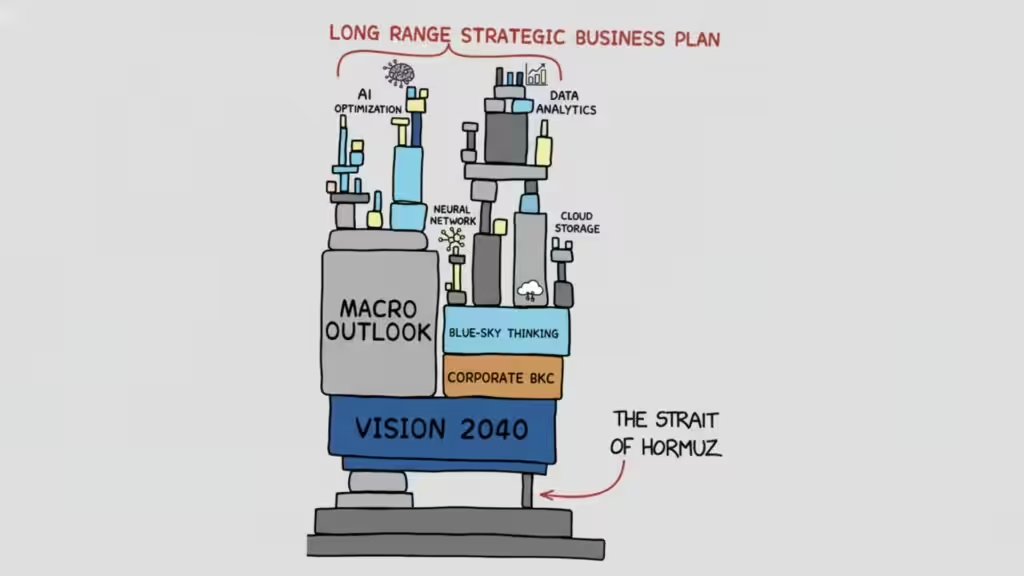
Elon Musk has used social media humor to make a point that thousands of business consultants could not. The billionaire posted a hand drawn cartoon on X showing a wobbly tower called “Long Range Strategic Business Plan.”
It is stacked high with every popular boardroom term you can think of. At the bottom sits “Vision 2040.” Above that, “Corporate BKC” and “Blue-Sky Thinking.” Even higher up, “Macro Outlook,” “Neural Network,” “Cloud Storage,” “AI Optimisation” and “Data Analytics” sit on top of each other like mismatched building blocks.
At the very bottom of the image, a small arrow points off the page to three words: “The Strait of Hormuz.”
The point is clear. The corporate world spends huge amounts of time on planning cycles, shiny slide decks, and jargon-filled roadmaps that stretch decades into the future. But a single major world event can make all of it meaningless overnight.
The timing is no accident. Iran has effectively closed the Strait of Hormuz after US and Israeli military operations against Tehran that began on 28 February 2026.
The closure has caused the worst disruption to global energy markets since the 1970s oil crisis. About one fifth of the world’s oil shipped by sea normally passes through that narrow waterway.
Do you know? Denmark flew blood supplies and explosives to Greenland, fearing US invasion.
Since early March, shipping traffic has dropped by about 95 per cent. Brent crude oil has jumped past US$126 a barrel. European and Asian natural gas prices have risen more than 50 per cent.
Insurance companies have stopped offering war risk coverage, and shipping companies have refused to send ships through without it.
Iran did not need a large navy to do this. A handful of drone strikes near the strait was enough to shut down the world’s most important energy route.
When reality moves faster than the plan
Musk’s cartoon connects with people well beyond the tech world. It speaks to a growing worry in corporate and across global markets about how fragile supply chains are. It also highlights the limits of business planning in a time of rising global conflict.
Boards across the ASX are facing the same hard truth: no amount of “blue sky thinking” or “AI optimisation” can protect against a war in the Persian Gulf, a pandemic, or a sudden shift between major world powers. These are no longer rare risks. They keep happening.
The cartoon also has a second, quieter layer of mockery. The buzzwords stacked in the image are not random. They are the exact words that have filled corporate plans for the past decade: artificial intelligence, data analytics, cloud infrastructure, neural networks.
Musk, who runs companies at the very front of each of these fields, seems to be making fun of businesses that treat these terms like magic words instead of real tools.
Putting “AI” on a plan does not make a business strong. Understanding the real world the business works in, including its need for shipping lanes and fossil fuels, matters a lot more.
Musk himself is not a neutral voice here. Tesla’s supply chain depends on global shipping. SpaceX works under US government contracts that are directly affected by Middle East stability.
Also read: Australian troops safe after Iranian strike near UAE base.
And his social media platform, X, has been criticized for the spread of AI generated false information about the very conflict the cartoon is about.
His ability to turn a complex world event into a single viral image is typically sharp. Whether he brings the same clear thinking to his own large group of companies is, as always, an open question.
Still, the cartoon has hit a nerve because the joke works. Somewhere in a glass tower in Sydney, London or New York, a strategy team is almost certainly updating a “Vision 2040” document right now. The Strait of Hormuz does not care.