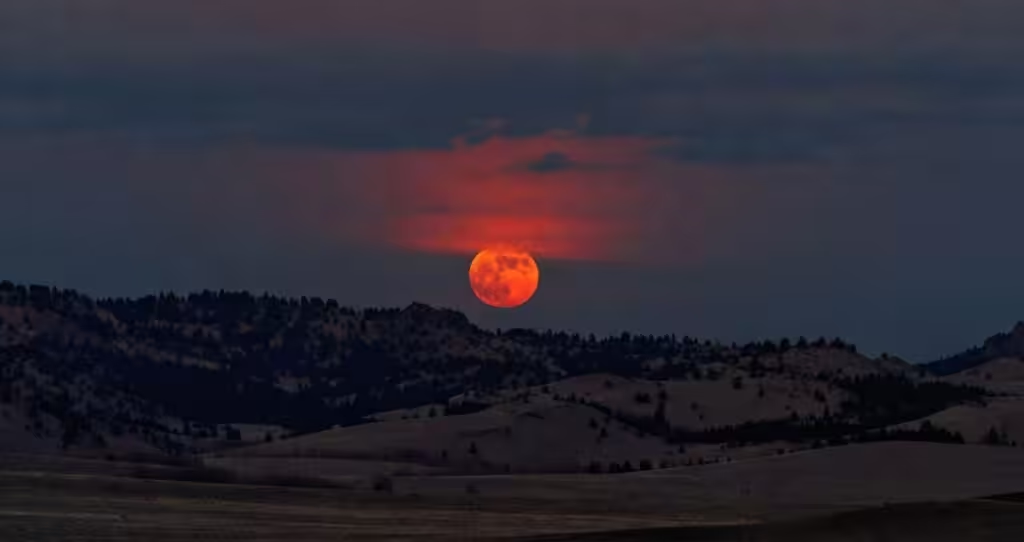

Australians are in for a treat next week, with a total lunar eclipse to paint the full moon a deep, coppery red on the night of Tuesday, March 3, into the early hours of Wednesday, March 4.
This phenomenon has also been known as a “blood moon.” The reason for the change in color is not due to trickery of the eye or smoke in the atmosphere.
During a total lunar eclipse, the Earth passes directly between the Sun and the Moon and most of the Sun’s light is blocked.
The light that does reach the surface of the Moon has been filtered through a thick layer of Earth’s atmosphere, which scatters colors in such a way that reds and oranges are dominant.
The majority of the landmass will be able to witness the totality, or the phase when the Moon is completely hidden inside the Earth’s darkest shadow.
The timings differ according to the state, but the totality phase is expected to occur between 7:04 pm and 8:02 pm Perth time (AWST), 8:34 pm and 9:32 pm Darwin time (ACST).
And 9:34 pm and 10:32 pm Adelaide time (ACDT), 9:04 pm and 10:02 pm Brisbane time (AEST), and 10:04 pm and 11:02 pm Sydney, Melbourne and Canberra time (AEDT).
There is no need for any special viewing equipment, and it is safe to view with the naked eye.
The only requirement is a clear path to the Moon, with darker spots that are not near bright streetlights being best for viewing the color change.
Binoculars or a small telescope can be used to enhance the edge of the shadow and the color changes on the surface of the Moon.
If cloud cover is a possibility, keep an eye on local forecasts closer to the time and be prepared to head elsewhere when the skies are clearer.
And you find yourself missing this event, the wait for the next total lunar eclipse visible from Australia is a long one with listings indicating the next total eclipse is late in 2028.