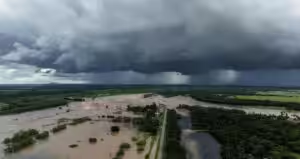
Queensland north west flood emergency has provided a first official view of how extensive the loss across grazing land has been, with producers claiming that over 16,000 head of livestock are missing or dead as river levels continue to be high.
The Queensland Department of Primary Industries had received reports of livestock losses and damage to 794km of fencing and over 1,400km of private roads.
The department expected these numbers to change as the water receded and more properties were able to assess and report the damage.
Large areas of the region were being sealed off for several days, making it difficult for the checking of herds and leaving surviving animals in the lower lying areas to be moved higher up.
The level of 4.05 meters in Winton exceeded the major flood level, leaving the outback region effectively cut off due to roads in being severed.
Elsewhere, crisis workers had been alerted in a flooded road in the area around Dimbulah, northwest of Cairns, where a motorhome had become stranded in floodwaters, while a man had to be rescued by winch.
The rescue serves as a reminder of the danger on the roads and floodwater crossings as the water rises in the streams.
On the Flinders, the Bureau of Meteorology was reporting major flooding was still occurring downstream of Richmond, with the river level at Walkers Bend at 15.90 m and and still rising.
The river level was expected to remain above the major flood level of 8 meters at Walkers Bend for the remainder of the week as water from upstream arrived.
Emergency support ramps up as cyclone threat builds
The governments have taken steps to support livestock welfare while farmers are still awaiting water.
As for water, an emergency package of support for fodder for a cost of $2 million at the price of drought relief assistance has been offered for the benefit of the primary producers of McKinlay Shire under the Disaster Recovery Funding Arrangements of the Commonwealth State.
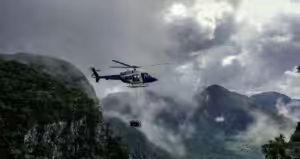
Queensland reconstruction agency reported that the package would assist in funding the extraordinary costs of the aerial delivery of fodder, including the costs of helicopters.
Some shires may also borrow disaster loans of up to $250,000 from the Queensland Rural and Industry Development Authority at a low interest rate.
While this is happening, another threat is being forecast offshore, with forecasters predicting that Tropical Low 12U had a moderate probability of developing into a cyclone by this Friday.
With the forecast indicating that the cyclone is to make landfall at Far North Queensland by Saturday morning, initially affecting ports between Port Douglas and Cape Melville.
There was a 35% chance that the cyclone would have reached cyclone intensity at that point, according to senior meteorologist Miriam Bradbury.
Although it may not turn into a cyclone, the bureau was warning of a heightened threat of very heavy rainfall and flooding for already waterlogged areas in the north and far north of the state of Queensland.
For the grazing industry, the initial cost of damages is the reality of the economic shock at the farm gate, with fences likely to be reduced in Integrity to allow easier access to properties and roads.
Authorities are encouraging producers to record the cost of damages using disaster impact surveys to determine further assistance in recovering the loss.